An HR process that subtly demotes candidates based on their names. An amazing facial recognition software in a demo, and an awful facial recognition software when tested on darker skin colors. A loan application algorithm that, for some reason, always ends up recommending the same zip codes. Not a single one of these algorithms was designed by anyone with ill intentions. These are all algorithms developed with accuracy, schedule, and clean code in mind, without ever questioning whether the input itself is biased. AI bias is not an abstract ethical dilemma discussed by the committee but a technical issue, which is no different from any other error in its root cause, except that it is much more difficult to find because it passes all the metrics in the books. This article dives into the nature of bias and how it can be identified and solved.
Table of Contents
What Is AI Bias?
ML models don’t create their worldview by guessing; they take it all from the dataset presented to them and all the patterns that come with it. If there are decades of unequal hiring, biased policing, and misrepresented demographics reflected in the data, then the ML model won’t correct for that bias, but will learn it by heart and apply it without question. That's what makes AI bias distinct from any software bug: even if the algorithm is completely error-free, the process is performed flawlessly, yet the model produces outcomes that are systematically and predictably unethical because it faithfully reproduces something fundamentally broken in its source material.
- Learning Patterns: Models Learn Correlation, Not Ethics. It is not up to the model to know whether something is right or wrong. It is only able to recognize patterns.
- Past Biases Become Past Data: Decisions made in decades on the basis of human biases become the norm that the model can reproduce.
- Confidence Factor: Being confident does not mean being right. The model can be very sure in its predictions and still be wrong in certain cases.
- Pipelines Propagate Bias: Minor biases in the data collection process may become magnified when passed through several stages of processing and training.
- Construction Bias: This is biased by construction as well. The people who choose the dataset, define the label set, and pick the evaluation metric dictate what "normal" looks like to the model.
From Where Does AI Bias Originate?
There is a temptation to view AI bias as a simple error that can easily be detected; however, it originates at several levels of the process and needs to be addressed at all. First of all, the data itself could be biased before any line of training code is run. Alternatively, the data may be good, but the labels, provided by an annotator, would carry biases within. In addition, both may be clean, but the measurement criteria would inadvertently favor certain outcomes.
- Sample Bias in the Raw Data: Certain demographics, geographical locations, or situations are just not represented in the initial dataset.
- Human Labeling Biases: Humans provide their assumptions as part of subjective labeling tasks, which get into the training signals.
- Protected Attributes: Proxy variables stand for protected attributes, where Zip code or name could unintentionally encode race or gender despite exclusion of those attributes.
- The Relation Between Metrics and Outcomes: Metric choice favors certain outcomes as it focuses on accuracy, as an overall metric that can hide bad results in certain subgroups.
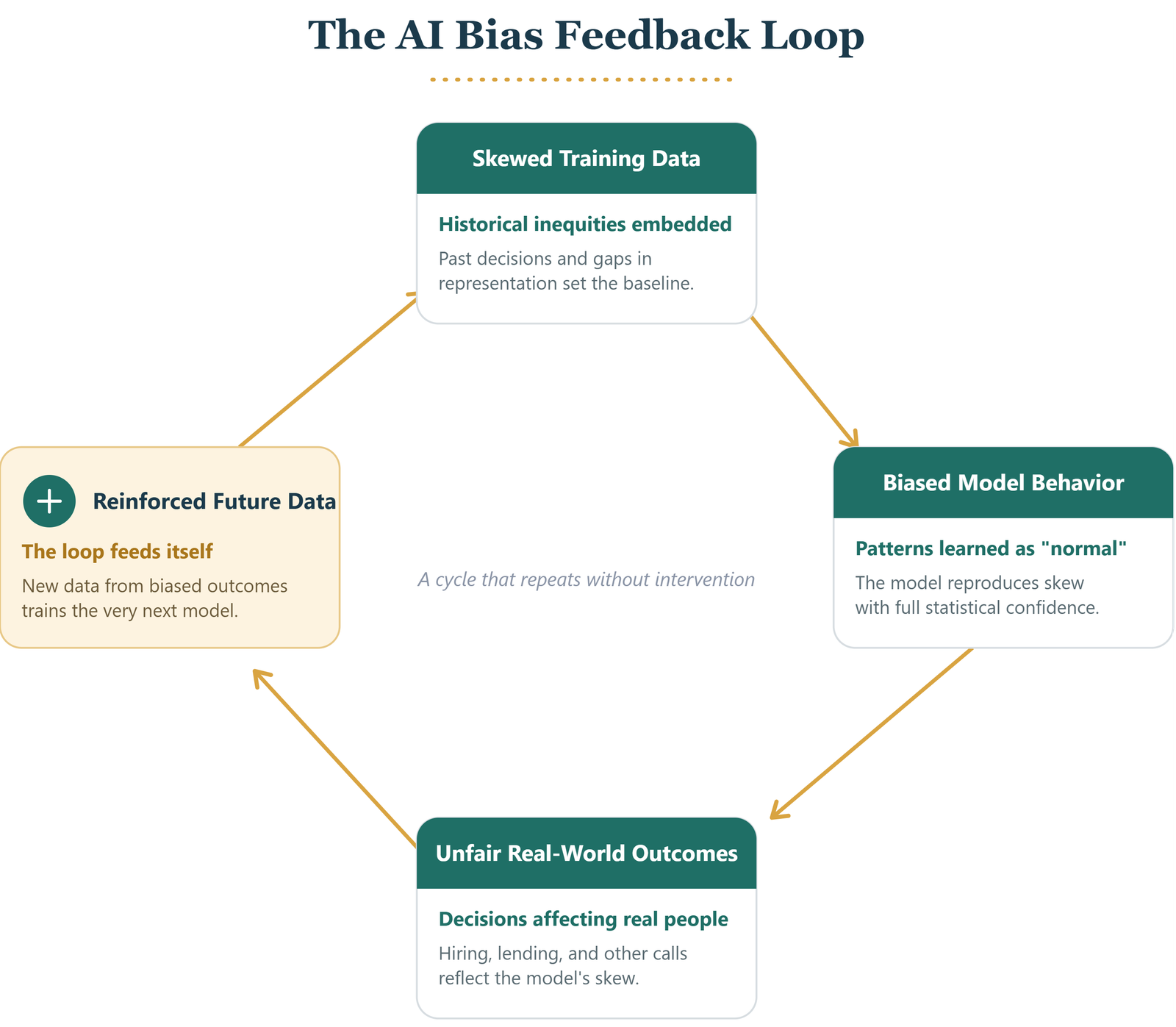
- Feedback Loop: The feedback loop amplifies early mistakes because biased model results are used to train the new models in the "real world".
Real-World Examples of AI Bias
Theoretical conversations about bias sound fancy, but when you look at actual failures that have happened in documented cases, it brings the problem of risk much closer to home. There are several examples in recent years that have made the connection between theory and reality quite clear. Understanding exactly what went wrong in each case makes it much clearer how these issues could be affecting your work.
A few notable real-world cases are as follows:
- Bias in a Resume-Screening Tool: An internal tool for hiring picked up a bias against certain applicants because it was trained on hiring data that was already biased.
- Biased Facial Recognition: Independent research showed much higher error rates for identifying faces of darker skin compared to light skin.
- Bias in a Healthcare Risk Estimator: A commonly used risk estimator consistently underestimated risk for one race, even though there were no differences in health.
- Redlining Biases in Credit and Lending Tools: Models that had been trained using historical loan data replicated redlining patterns from the past.
- Language Models Producing Stereotypes: Large language models produced gender and ethnic stereotypes about various professions and qualities.
Types of AI Bias
It is not true that all biases are the same, and classifying them all under the same broad term makes it difficult to diagnose the actual problem that might be occurring in any particular system. Researchers have categorized the concept of bias into a few broad categories, each of which can be identified and addressed based on certain specific symptoms.
Below is the comparison of different types of bias:
| Type of Bias | What Causes It | Typical Signs to Notice |
| Sampling bias | Certain groups are underrepresented in the training data | The model performs noticeably worse for underrepresented groups |
| Historical bias | Past human decisions embedded in the data reflect old inequities | Outputs mirror patterns from a discriminatory past, even with "clean" code |
| Measurement bias | Features or labels are measured inconsistently across groups | Accuracy varies depending on how the data was originally collected for each group |
| Aggregation bias | A single model is applied uniformly to groups with different underlying patterns | Strong average performance masks poor performance within specific subgroups |
| Confirmation bias in labeling | Human annotators unconsciously favor expected outcomes | Labels skew toward stereotypical patterns even when raw data doesn't support them |
Why AI Bias Should Concern Developers and Not Just Researchers?
It's easy to think that fixing bias in ML systems isn't our problem, but someone else's, and we only need to pass on the responsibility to policymakers, ethics boards, and data scientists upstream. The reality is that developers are the final gatekeepers against biased systems that affect actual users. The decisions about what actually makes it into deployment matter more than just what goes into training the system.
- Priority Testing: Developers decide which features to test. Test suites are typically created by developers, and the groups that aren't tested are invisible risks.
- The Decision Factor: How the cutoff of the classification happens determines who's flagged, who is approved, and who is rejected.
- Running Environment: The environment in which the model runs changes the risk. What might work in research can have a totally different effect when the system starts making decisions about real users.
- Human Feedback: User complaints often become the first reports of biased systems. The developers maintaining the system become aware of the biases from user complaints.
- Time and Cost: Implementing the fixes later is exponentially more expensive. It's always much easier and cheaper to fix the problem during the development process.
Detection of AI Bias
Discovering that a model exhibits bias during its deployment phase means that users have likely experienced this bias and have been impacted. This alters the whole risk equation. In order to address the issue, organizations should consider fairness testing to be a legitimate part of the development process and not an add-on step to perform just before the release. Here is a set of tangible practices that can enable organizations to do so even when there is no specialized team for fairness research in the organization.
- Performance Factor: Performance is checked by breaking it down into subgroups. Testing accuracy, precision, and recall of different demographic groups separately, rather than using an aggregated single value.
- Impact Testing: Comparison of outcome rates between groups to identify whether one particular group experiences a disproportionate effect of the decision.
- Adversarial and Edge Case Testing: Intentionally applying certain outlier inputs to a model in order to provoke unintended or unfair behavior.
- Audit of Datasets: Checking the origin of the dataset used for training the model and whether the group is well represented.
How to Resolve AI Bias
Identifying bias is useful only if it translates into some form of remedy, and the right remedial action varies depending on where in the process the flaw occurred. Some flaws need fixing at the level of the data, while others should be tackled at the model or at the decision-level that sits atop the model. It is seldom possible to pinpoint one silver bullet of a solution, which is why the most successful mitigation techniques involve combinations of these different types of solutions.
- Refinement of Data: Balancing or augmentation of the training dataset is done by adding new examples from the underrepresented groups. One can fix the sampling problem.
- Training-Time Reweighting: During the training phase, one could weight different samples in accordance with certain pre-defined criteria.
- Optimization: Constraint optimization of the model in training is done by some techniques that actually seek to make all groups perform equally well.
- Post-Processing: Different threshold levels for different groups can be applied as a means of correcting any group disparity without having to train the whole model anew.
- Human Feedback: Human-in-the-loop review for high-stakes decisions is necessary, as keeping a human reviewer in the loop for consequential decisions adds a safety net that automated systems alone can't provide.
Can AI Bias Be Fully Eliminated?
It would be nice to suggest a clear solution to the problem, but there is none. This is because, if bias comes from reality and is rooted in data, it is impossible to get rid of it without changing reality. A more achievable goal would be its reduction, along with transparency concerning the system's shortcomings.
- Contradiction Issue: Fairness criteria may contradict one another; for instance, optimal in one sense, algorithms can become far from optimal in terms of another measure of fairness.
- New Bias: Bias can come again when new data appear, as algorithms cannot be corrected only once since new data will make them biased.
- Bias is Difficult to Detect: There are intersectional types of bias that affect a specific subpopulation, which are very hard to detect using traditional techniques.
- What Is Fair Changes: Fairness criteria change with the context of application and stakeholders' interests.
- Importance Of Transparency: Transparency is as important as the solution itself because disclosure of limitations of the algorithm is not an issue of admitting failure.
Best Practices for Preventing AI Bias
One-time bias audit before launch is a good start, but it doesn't suffice for long-term maintenance of a system's fairness. The successful teams tend to think of fairness as a constant part of engineering practice embedded in workflows, not as something that needs to be done prior to launch. Cultivating this practice early is usually much easier than retrofitting it into an existing problematic system. Some Practices include:
- Add Fairness Tests Into CI Pipelines: automated testing of model performance on subgroups can go along with unit and integration tests.
- Tracking the Data: Track provenance of your training data from the very beginning to know where the data was taken from greatly simplifies later audits.
- Schedule Regular Re-Evaluations: periodically checking deployed models helps to notice any drift and prevent bias accumulation.
- Feedback System: Make it easy to raise concerns about fairness so that teams that don't punish reporting possible problems tend to identify them earlier than teams that discourage such reporting.
- Staying Updated: Stay informed about new developments in fairness research and practices.
Conclusion
AI bias is not some isolated phenomenon that only emerges in ill-designed algorithms, but a natural product of using real data, which inevitably contains existing disparities, to train models, which means it may appear in any software that was developed with the best of intentions. Whether it is a matter of responsible engineering or of unintentional harm done to someone lies not in the absence of the problem, but in developers being aware of it and actively seeking it before something goes wrong and a user complaint emerges. The methods to do so are known to us, including the use of subgroup testing and fairness-aware approaches to machine learning, yet all they will ever be capable of achieving is their integration into the process of developing software rather than serving as an add-on that comes after the release.
Frequently Asked Questions
1. Can AI bias be completely eliminated?
Not entirely because bias often originates from real-world inequities in the data itself, the realistic goal is meaningful reduction and ongoing monitoring, not a permanent, one-time fix.
2. Is bias only a problem for large, high-stakes systems like hiring or lending?
No. Smaller systems, like recommendation engines or chatbots, can also exhibit bias, and the impact scales with how many people the system affects and how consequential its decisions are.
3. Whose responsibility is it to catch bias, developers or data scientists?
Both. Data scientists shape the training process, but developers control testing, thresholds, and deployment decisions that directly determine whether bias reaches real users.
4. Does removing protected attributes like race or gender from the data solve the problem?
Not by itself. Proxy variables, like zip code or name, can still indirectly encode those same attributes, so removal alone rarely eliminates the underlying bias.
5. How often should a deployed model be rechecked for bias?
Regularly, not just once before launch. Data patterns and real-world conditions shift over time, so periodic re-evaluation helps catch newly introduced or evolving bias.

0 Comments