AI is no longer an experimental technology; it drives payments, customer service, build processes, and autonomous entities that can execute physical actions. With increasing capabilities of AI, safety is no longer limited to the accuracy of models. Safety also implies prevention of data leaks, attacks, failures, and maintaining human intervention for decision-making that affects real life.
For software developers, AI safety is equally important as coding security. You don’t have to be an AI researcher to practice safety; knowing common pitfalls and adopting techniques for their prevention will suffice. That’s what this article is all about.
Table of Contents
What Is AI Safety?
AI safety refers to the various strategies that help to ensure that the AI model works properly, remains secure from any misuse, and fails gracefully, rather than failing unpredictably and harmfully. It includes:
- Safety Goes Beyond Accuracy: Even if the accuracy is high, an AI model can be unsafe, as safety is associated with other aspects, including robustness, privacy, controllability, and behavior during adversarial conditions.
- Responsibility of Everyone Involved: Safety is not only the concern of those developers who are working on the state-of-the-art models; all those who train and use models have some responsibility for it.
- Safety Across the System Lifespan: Safety is not related to the process of launching the model alone but includes its entire lifespan, including data collection, training, and even shutdown.
- Dynamic Concept: As models become more autonomous and capable of using tools, the concept of safety changes constantly.
Why Does AI Safety Matter?
- Practical Implications Growing: The integration of AI into payment systems, code storage, and customer data means that there is more at stake beyond getting the right answer.
- Hackers Keep Moving Fast: Prompt injection, data extraction, and model manipulation methods keep changing, and unsecured AI becomes a vulnerable target.
- Automation Leads to Error: With actions taken by autonomous AI agents that aren’t subject to human approval every step of the way, there is no room left for errors.
- Trust Equals Success: People and companies will accept new technologies much more easily if they feel comfortable doing so; even one incident can undo months of effort.
- Regulation Follows Trends: AI safety moves from advisory guidelines into mandatory rules as more governments and industries work towards regulations.
How AI Safety Works?
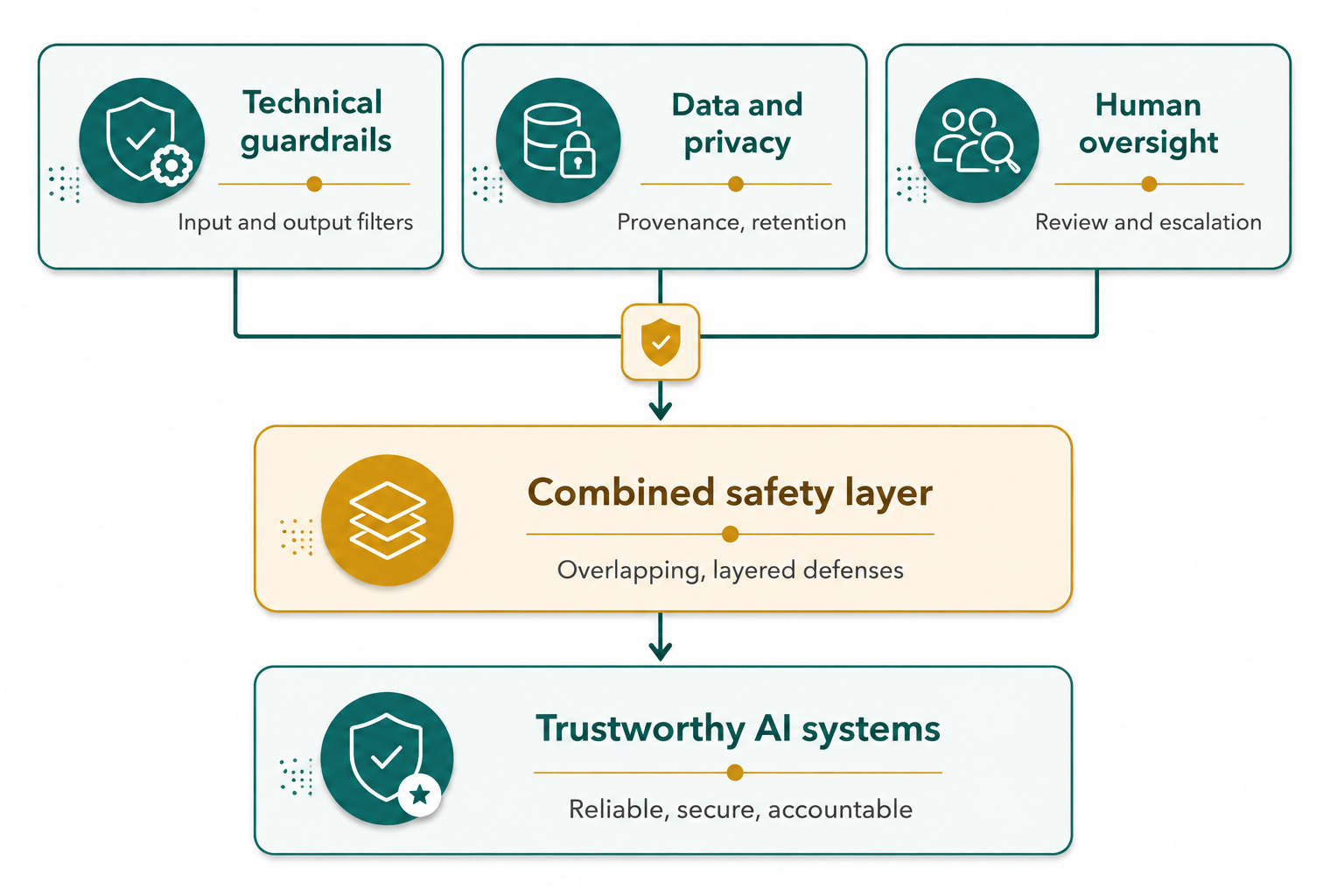
- Multiple Overlapping Defenses: Security must have many layers, with various types of input/output validations, monitoring, and human reviews in place to ensure that even a single point of failure does not bring down an entire security apparatus.
- Proportional To Threat Level: How extensive the safety measures should be depends on the risk involved, which means that a support chatbot does not require the same level of safety as a financial transaction service.
- Integrated Into Development Process: The more safety measures are integrated directly into the pipeline, the better, rather than just relying on manual code review for safety purposes.
- Ongoing Verification: Continuous safety testing, rather than one-time certification, is a key part of ensuring the safety of LLM-powered products and services.
- Collective Responsibility: It makes sense to involve everyone in ensuring the safety of the product, rather than just leaving it to one specialized team.
Foundations Of Safety
- State The Stakes: Start with an open conversation about what your system is intended to do and what will go wrong if you get it wrong. The proper amount of safety resources will depend on your answer.
- Model Threats From The Start: Think through who will try to use your product for malicious purposes and how. Don’t wait until after launch to consider security prompt injection, data extraction, and exploitation of tools your model can access; all fit here.
- Create Separate Channels: Never have your input data and your control instructions go through the same channel. If you do, you’re opening the door for prompt injection attacks.
- Assume Imperfection: Take every output generated by your AI as an idea provided by an imperfect partner rather than a fact, and incorporate a step to check for the validity of any output that touches your bottom line.
- Maintain List of Limitations: Maintain a list of things you know your product cannot do. It’s where your next problem is going to come from.
Technical Guardrails
- Rigorous Input Filtering: Filter injection attempts, payloads, and adversarial language patterns from your prompt before passing them to your model’s logic at all.
- Output Scanning: Scan output for secrets and personal data or any unintentionally executable code before passing it on to an end user.
- Defensive Layering: Don’t just apply one set of guardrails, but make sure your filters, scanners, and monitors catch whatever the other doesn’t.
- Rate Limit Everything: Limit how many times your model or agent uses a tool API or external service per second to mitigate risk in a compromised session.
- Logging for Forensics: Record everything about the prompt, the tool API calls, and the output in a way that allows for forensic reconstruction of the problem.
Data And Privacy Discipline
- Source Trace for Track Data: Make sure you know the exact origin of the data used for training and fine-tuning, and that its use complies with licensing and consent requirements.
- Sensitive Data Minimization: Remove any personally identifying data before it enters any prompt or training dataset; the fewer sensitive data points the model has contact with, the lower the risk.
- Retention Windows: Have policies in place dictating the window period for which logs, embeddings, and caches are retained, and when they should be purged.
- Vet Any Third-Party API: Each one is another data-sharing arrangement; treat them the same way you would a new vendor contract.
- Anonymize First: Anonymize before using for improvement purposes. Using real user data to improve the model? Stripping personally identifiable data first avoids creating a privacy hazard during debugging and analysis.
Testing And Evaluation
- Explore Edge Cases: It’s not just about verifying that the system performs well on the expected inputs; you need to see how it fails by actively testing the inputs where it might fail.
- Look for Graceful Rejection: The well-designed system should be able to refuse to fulfill requests that are out of its scope and not make a wild guess.
- Evaluate Calibrated Uncertainty: See if the model can recognize when it doesn’t know anything rather than trying to make a guess with full certainty.
- Red Team Your System Before Launching: You need to have a dedicated team looking to bypass your system’s guardrails before your actual users can do that.
- Reevaluate Safety Metrics After Updates: Each time you update the model, the prompt, or fine-tune it, it becomes a different system.
Human Oversight And Control
- Decision Loops: Maintain humans in the high-risk decision-making loop. If an operation has any implications, legal or otherwise, insist on having humans in the decision loop prior to execution, not total autonomy.
- Create an Escalation Path: Create an explicit mechanism in which a system alerts a human about ambiguity, rather than blindly executing the operation.
- Provide Agents With Unique Identities: Each agent must have its own identity and permissions, not a common service identity. This way, the damage of any breach will be contained to the individual agent.
- Restrict Inescapable Actions: Have confirmation steps built into the process prior to allowing the AI system to perform an irreversible operation.
- Validate the Oversight Process: In case AI systems are used for oversight of other AI systems, periodically check if they’re actually catching any problems.
Governance And Culture
- Keep Your Model Inventory Up To Date: Record all AI models you are using, who owns them, what they do, what data they rely on, and their current risk status so that nothing goes unnoticed.
- Establish Ownership: Each of your models or agents needs to have an owner who will be responsible for its behavior throughout the system’s lifecycle.
- Reference Existing Frameworks: Compare your practices with already existing frameworks, such as the NIST AI Risk Management Framework, to ensure you don’t create an approach from scratch.
- Educate All Team Members: It is not safe to rely solely on your safety engineer’s expertise; everyone involved in the development should know how your system fails and how to report it.
- Reporting Friendly Environment: Create an environment where reporting is incredibly easy. If it takes too much effort to report a near miss or unusual behavior, it might never be reported.
Conclusion
The issue of AI safety is not just about deploying technology once; it is a continuous process that will adapt with increasing capabilities and autonomy of the technology being deployed. The organizations that do well are those that recognize the threats early on, test extensively, keep humans in the loop where necessary, and validate their AI.
Frequently Asked Questions
1. Is AI safety only relevant for large enterprises building frontier models?
No. Any developer integrating a third-party model into a product inherits safety responsibilities from securing prompts and outputs to protecting user data, regardless of whether they trained the underlying model themselves.
2. What's the difference between AI safety and AI security?
AI security typically focuses on protecting systems from external attacks like prompt injection or data exfiltration, while AI safety more broadly covers ensuring the system behaves as intended, including avoiding harmful, biased, or unreliable outputs even without malicious intent.
3. Do I need a dedicated safety team to build responsibly?
Not necessarily at a small scale, but every team should have clear ownership of safety practices, and someone accountable for reviewing risk as the system grows. This can start as a shared responsibility before becoming a dedicated role.
4. How often should safety testing be repeated?
Safety testing should be treated as continuous rather than one-time. Rerun evaluations after any model update, prompt change, fine-tune, or significant shift in how the system is used in production.
5. Why does human oversight matter if the AI is usually accurate?
Accuracy on average doesn't protect against high-impact edge cases; human oversight exists specifically to catch the rare but consequential failures that automated testing and typical usage patterns don't surface.

0 Comments