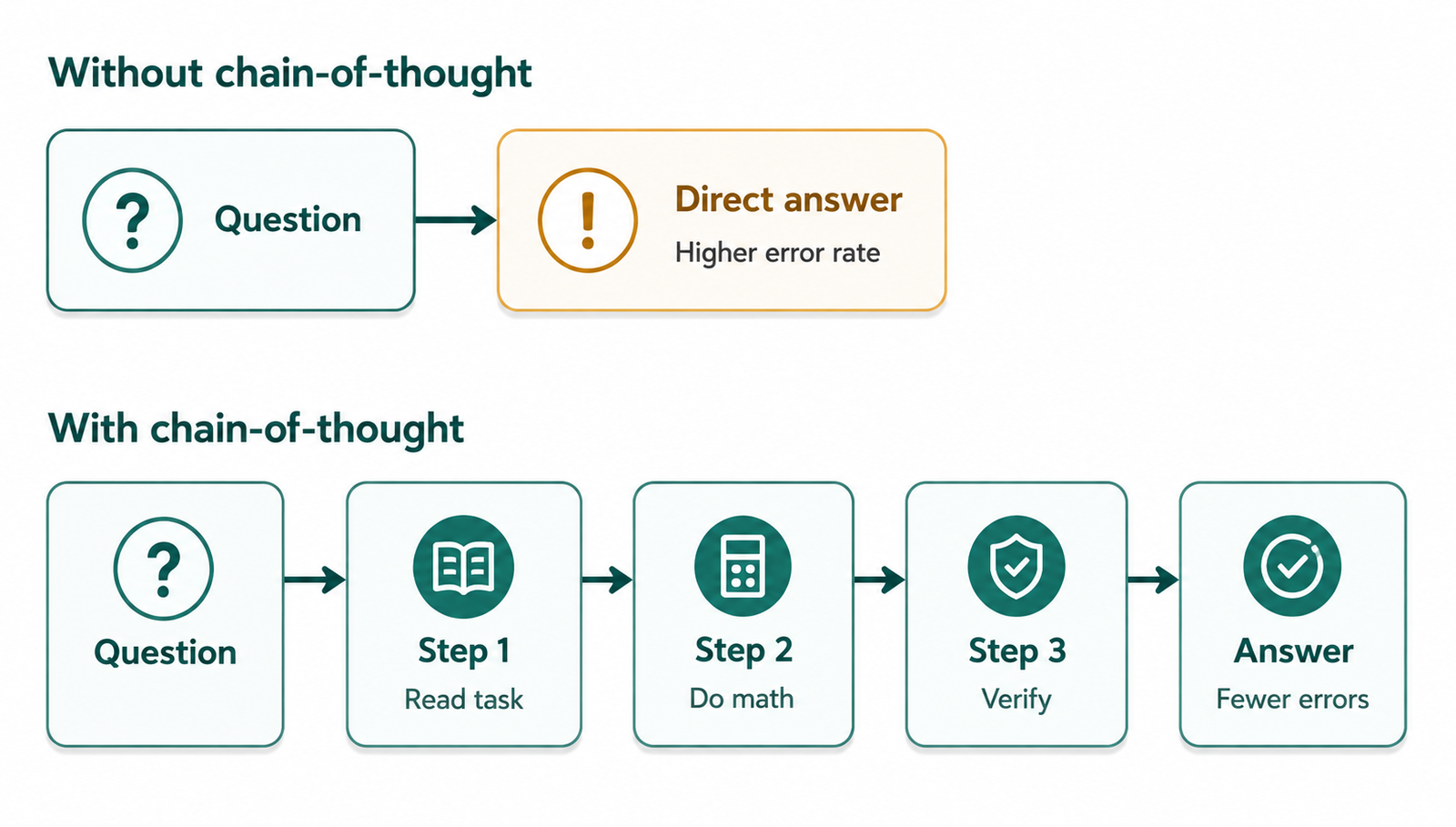
For many years, large language models had been working in a less efficient way: fast and accurate but with a high chance of error for complicated problems. Research showed that asking models to “think step-by-step” significantly increased their accuracy levels. It became one of the most important developments in the application of language models, referred to as the Chain-of-Thought (CoT) prompting method.
The significance of this method lies in the fact that no additional model or training was needed; only the prompt was changed. This approach helped to unlock the reasoning skills within the model. This article highlights how CoT prompting works, its applications, limitations, and impact on human-AI interaction.
Table of Contents
What Chain-of-Thought Prompting Actually Means
It’s important to know the essence of the concept, what issue it addresses, and what made this innovation necessary.
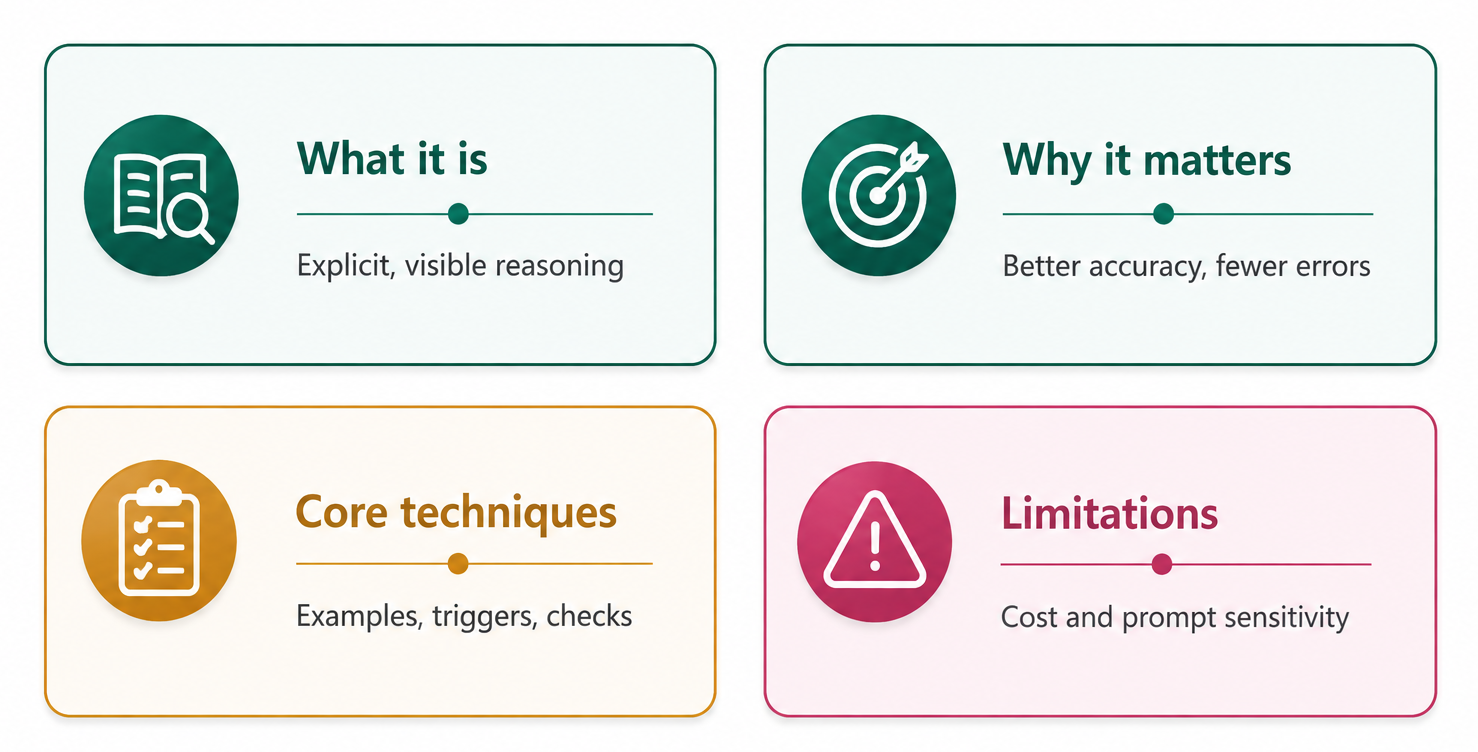
- Chain-of-Thought Prompting: This technique tells the model to split the problem into a chain of reasoning steps before providing a final answer.
- Reasoning Process Visualization: In addition to providing a final answer, the model must show the process of its reasoning in the form of natural language.
- Emergent Property: It turned out that this behavior emerges only in sufficiently large models, meaning it’s an emergent ability.
- Change Only at Prompt Level: The enhancement comes exclusively from modifying the prompt, while not changing anything about the model itself.
- Human Equivalent: This technique works similarly to the way humans solve new problems - by verbalizing the reasoning process step-by-step.
Why Standard Prompting Falls Short?
To understand the need for Chain-of-Thought, it would be wise to look into what occurs when a model is required to produce an answer without being able to think about it.
- Direct Answering: Traditional prompting makes the model generate an answer directly, without any breaking it down into small steps during the process.
- Accumulation of Errors: Many problems require doing all the small steps correctly. If one only provides the answer at the end, there will be no way of correcting any errors that might have been committed before.
- Surface Pattern Recognition: Since there is no process of reasoning, a model resorts to finding surface patterns instead of solving a problem.
- Math Weaknesses: Arithmetic problems, logic problems, and questions that require multiple steps of reasoning are hard for models to solve.
- Lack of Transparency: No possibility of seeing the process of reasoning makes it impossible to spot an error.
Core Techniques for Effective Chain-of-Thought Prompts
Not all thinking prompts are the same. This part talks about the specific techniques that distinguish an average CoT prompt from an effective one.
- Explicit Instruction: Adding something like "Think step-by-step in solving this problem" in front of the question makes the model go into reasoning mode.
- Few-Shot Examples: Giving the model two or three examples in which the full reasoning path is shown teaches the model the format.
- Zero-Shot Trigger: There are some trigger phrases that can cause reasoning without any example being provided.
- Self-Consistency Check: Reasoning different paths independently and selecting the answer that comes up in the majority of the reasoning paths helps when there are ambiguous problems.
- Structure Breakdown: Making the model break down the problem into smaller parts before solving.
Where Chain-of-Thought Prompting Delivers Real Value?
Grasping the theory is one thing, but knowing how it makes a difference in practice is something else.
- Math Problem Solving: Problems of arithmetic and word problems yield the greatest improvements in accuracy due to the need for precise and structured logical thinking.
- Logical Puzzles: Riddles and problems of satisfying constraints are aided by the model’s ability to consider several conditions in separate sentences.
- Code Debugging: Looking at the execution of a piece of code line-by-line allows the model to spot bugs in the code that may otherwise go unnoticed.
- Legal Analysis: Analyzing contract details or case facts through sequential reasoning yields more plausible results.
- Complex Decision Making: Questions regarding business or strategy decisions benefit from considering the trade-offs involved.
Limitations and Common Errors
Chain-of-Thought prompting is powerful, but it is not magic. Knowing its weak points prevents over-reliance on the technique.
- Fluent Nonsense: A model can produce reasoning steps that sound relevant and confident while still arriving at the wrong conclusion.
- Longer Outputs: Reasoning chains consume more tokens and processing time, which raises both cost and response latency.
- Small Model Limits: The benefits of this technique shrink or disappear entirely in smaller models that lack the capacity for structured reasoning.
- Prompt Sensitivity: Minor changes in wording can significantly change whether the model reasons well or reverts to shallow answering.
- False Transparency: A visible reasoning chain is not proof the model actually "used" that logic to reach its answer.
Best Practices for Prompt Designers
Making the theory work in a rigorous manner involves some level of discipline when writing the prompts.
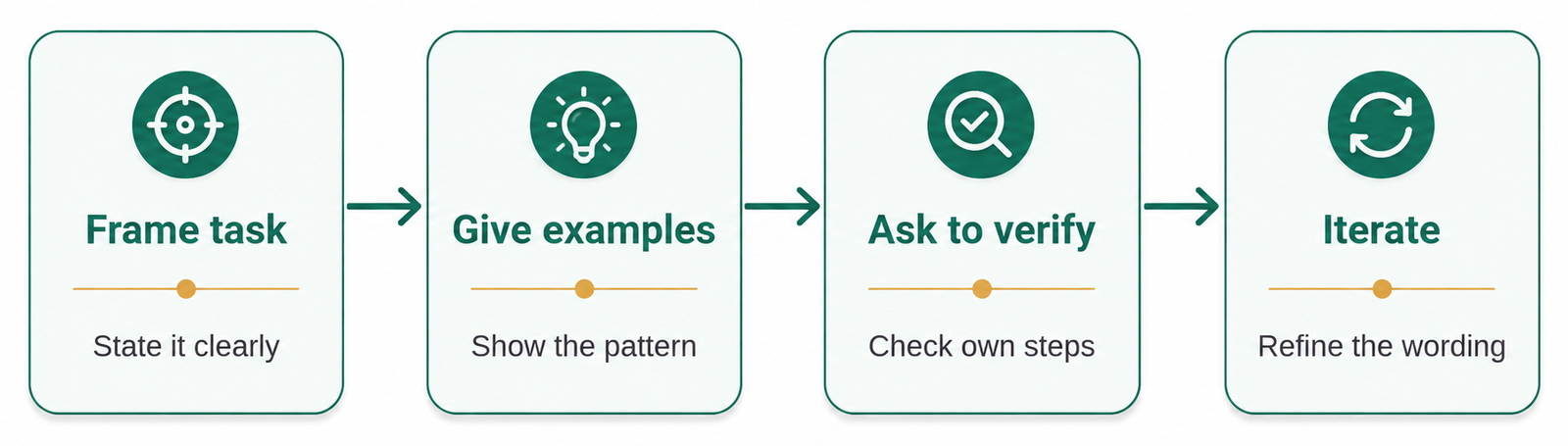
- Explicit Task Definition: Clearly define the task and the format of the expected answer before getting the model to reason.
- Relevant Examples: In few-shot prompting, pick examples that have a similar difficulty level and structure as the target problem.
- Verifying Reasoning: Ask the model to verify its answer through reasoning before coming up with the final solution.
- Lower Temperature: Reducing the randomness in the prompts allows for better reasoning and avoids illogical jumps.
- Iterative Prompt Experimentation: View the prompt as a trial and test different prompt formats based on where the reasoning fails.
The Road Ahead for Reasoning Prompts
However, Chain-of-Thought prompting marked an early achievement, and the area is still advancing based on the same core principle, namely that the process of reasoning can be influenced and enhanced through proper prompting and training.
- Reasoning Built-In: Modern models are now capable of performing internal reasoning by default, and it's becoming less necessary to prompt them to do so.
- Tool Integration: Reasoning chains can now be supported with calculators, programming, and searching tools to check their intermediate results.
- Automatic Prompting: Some models have become capable of generating the best prompts for reasoning automatically, instead of trying different combinations manually.
- Multi-Agent Reasoning: Multiple instances of models are being made to debate with one another in order to find mistakes in their reasoning chains.
- Evaluation Criteria: A new set of criteria for evaluation is being developed to assess the faithfulness of the generated reasoning chains.
Conclusion
Chain-of-Thought prompting completely changed the way people think about the process of interacting with AI systems; no longer was it seen as a kind of vending machine for quick answers; instead, it became evident that this interaction was a reasoning partner that works better if there is enough space for thinking aloud. It revealed the very basic yet extremely profound idea that most of the so-called "capability gap" in AI was actually a "prompting gap". The AI models have more reasoning capabilities than straightforward questions would allow to find. By dividing tasks into smaller parts, by providing work samples, and by adding the verification step, one can systematically extract better reasoning from the very same AI model.
Frequently Asked Questions
1. Does Chain-of-Thought prompting work on every AI model?
No. It tends to work best on larger, more capable models. Smaller models often don't have the capacity to produce coherent multi-step reasoning, so the technique can even hurt performance in those cases.
2. Is Chain-of-Thought prompting the same as an AI model "thinking"?
Not exactly. It produces a written reasoning trace that resembles thinking, but this trace doesn't always faithfully represent the internal computation that produced the final answer, it can sometimes be a plausible-sounding explanation generated after the fact.
3. Does using Chain-of-Thought prompting always improve accuracy?
No. On simple factual questions, it can add unnecessary length and even introduce new errors by overcomplicating a straightforward answer. It's most valuable for multi-step, logic-heavy problems.
4. Do I need to provide examples for Chain-of-Thought prompting to work?
Not necessarily. Zero-shot triggers, such as asking the model to reason step by step, can work without examples, though few-shot examples generally produce more consistent and structured results.
5. How is Chain-of-Thought different from simply asking an AI to "explain its answer"?
Explaining after the fact only justifies a decision already made. Chain-of-Thought prompting asks for the reasoning before the final answer, so the reasoning steps can actually influence what that answer turns out to be.

0 Comments