The real challenge is not difficulty; it’s direction. If you follow the wrong order, even simple topics feel hard. If you follow the right order, things start connecting naturally.
This roadmap is built to give you that direction. It tells you exactly what topics to study, in what order, and how to practice them effectively, along with a practical way to use AI without becoming dependent on it.
Table of Contents
Why DSA Matters?
DSA is not just about solving coding questions. It trains you to think in terms of logic, constraints, and efficiency. It is also the foundation of most technical interviews. Here are some key benefits of learning DSA:- Problem Solving: You learn how to convert a real-world problem into a structured approach using steps, conditions, and data handling.
- Interview Preparation: Most companies ask questions based on arrays, strings, trees, recursion, and dynamic programming.
- Efficient Coding: You learn how to reduce time complexity using techniques like hashing, binary search, and optimized traversal.
- System Thinking: You begin to understand how data flows and how performance is affected by design choices.
Programming Basics
Before starting DSA, you must be comfortable writing and understanding code in one language, such as C++, Java, or Python. You should not move forward until these basics feel natural. Here are some important topics to cover:- Data Types: Learn integers, floating-point numbers, characters, and strings. Practice type conversion and basic input/output handling.
- Loops Practice: Work with for and while loops. Solve pattern problems and iterate through arrays using loops.
- Conditional Logic: Practice if-else conditions, nested conditions, and switch statements. Solve problems based on decision-making.
- Functions Usage: Learn how to create functions, pass parameters, and return values. Practice writing small reusable functions.
- Array Basics: Solve problems like finding the maximum and minimum element, reversing an array, and calculating the sum of elements.
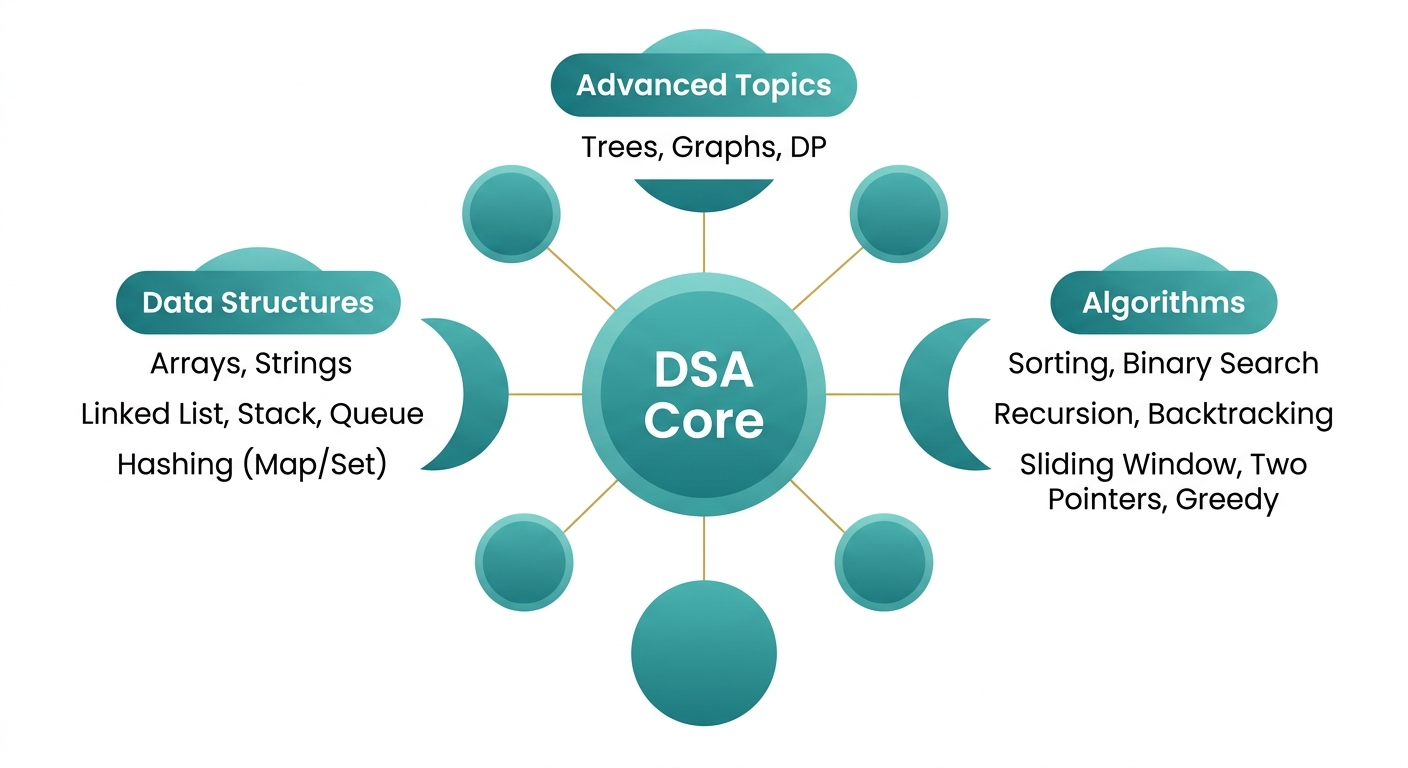
Core Data Structures
Once your basics are clear, move to data structures. These define how data is stored and accessed.- Arrays Practice: Solve prefix sum problems, subarray sum problems, Kadane’s algorithm, and frequency counting.
- String Problem: Practice palindrome checking, anagram detection, substring search, and character frequency counting.
- Linked Lists: Learn insertion, deletion, reversing a linked list, detecting cycles (Floyd’s algorithm), and finding the middle node.
- Stack Problems: Solve valid parentheses, next greater element, and expression evaluation problems.
- Queue Problems: Practice circular queue, deque operations, and sliding window maximum.
- Hashing Techniques: Use hash maps and sets for problems like two sum, duplicate detection, and frequency-based questions.
Key Algorithms
After understanding data structures, focus on how to process data efficiently.- Sorting Algorithms: Learn bubble sort, selection sort, and insertion sort for basics. Then move to merge sort and quick sort.
- Binary Search: Practice standard binary search, lower bound, upper bound, and searching in rotated sorted arrays.
- Recursion Practice: Solve factorial, Fibonacci, subset generation, and recursion tree problems.
- Backtracking Problems: Work on permutations, combinations, N-Queens, and Sudoku solver.
- Sliding Window: Solve problems like the longest substring without repeating characters and the maximum sum subarray of size k.
- Two-Pointer Technique: Practice pair sum, sorted array problems, and removing duplicates in-place.
Problem Solving Strategy
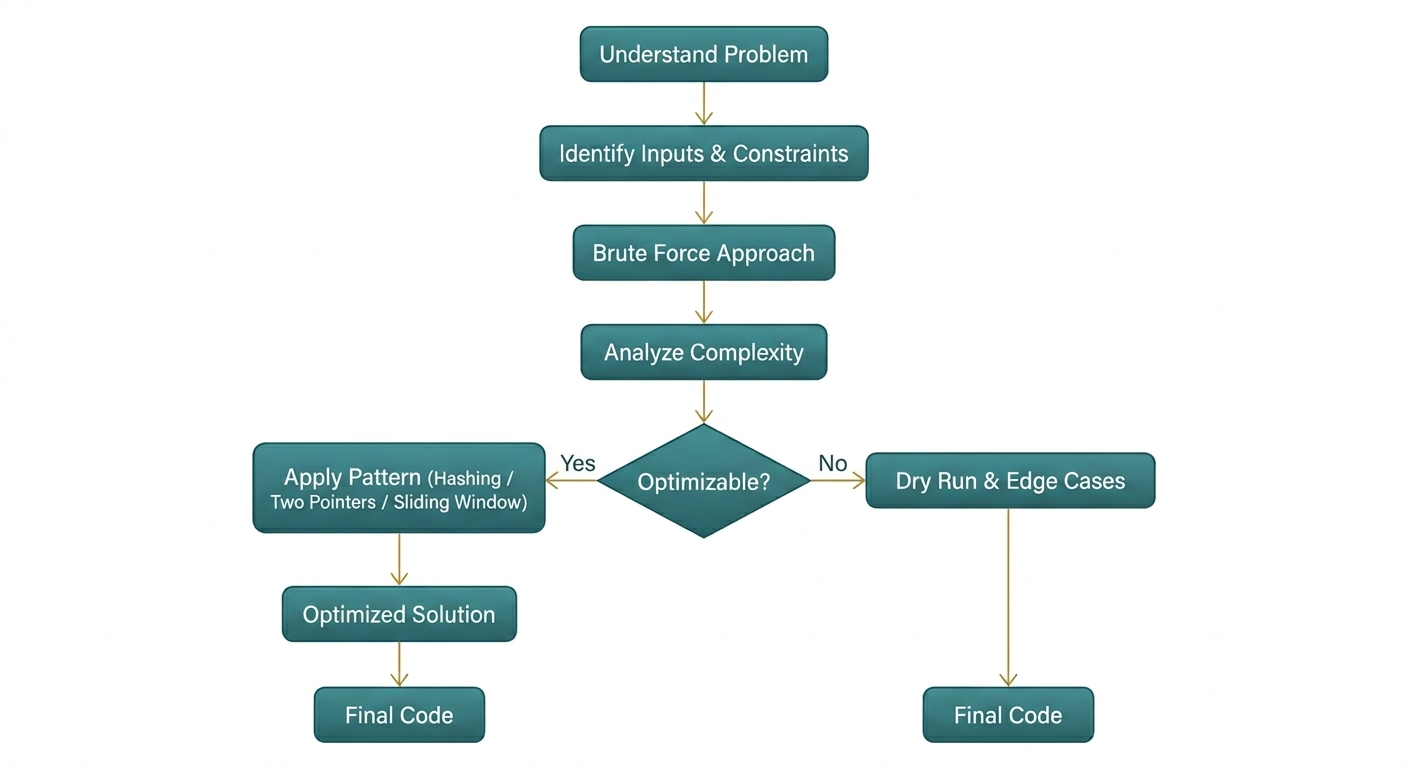
Knowing topics is not enough. You need a clear method to approach problems. Here is a step-by-step approach that can be followed for problem-solving:- Problem Analysis: Identify inputs, outputs, constraints, and edge cases before writing code.
- Brute Solution: Write a simple approach using loops or recursion, even if it is inefficient.
- Optimization Step: Improve the solution using techniques like hashing, binary search, or two pointers.
- Dry Run Practice: Test your logic using sample inputs and edge cases such as empty arrays or single elements.
- Pattern Recognition: Identify if the problem matches common patterns like sliding window, recursion, or graph traversal.
Practice Roadmap
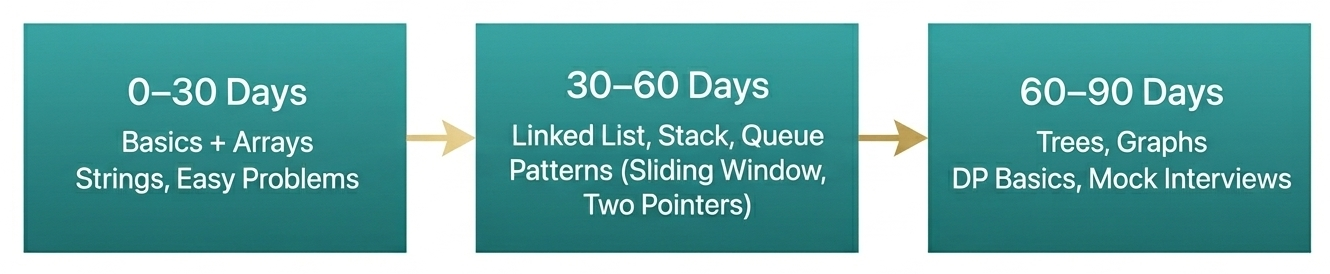
Your progress depends on how consistently you practice.Beginner Level (0–30 Days)
- Array Focus: Solve problems like the second largest element, reverse array, prefix sum, and basic subarrays.
- String Focus: Practice palindrome, anagram, and frequency count problems.
- Easy Questions: Solve problems like two sum, valid palindrome, and basic searching problems.
- Linked List Practice: Solve reverse list, detect cycle, merge two lists, and find intersection.
- Stack Queue: Practice valid parentheses, next greater element, and queue implementation.
- Pattern Problems: Apply sliding window and two-pointer techniques on real questions.
- Tree Concepts: Learn inorder, preorder, and postorder traversal, height of tree, and diameter.
- Graph Basics: Study BFS, DFS, adjacency lists, and simple graph traversal problems.
- Dynamic Programming (DP) Introduction: Solve Fibonacci using DP, climbing stairs, and basic knapsack problems.
AI Practice Strategy
AI can help you learn faster if used correctly.- Concept Learning: Ask for simple explanations of topics like recursion, graphs, or DP with examples.
- Hint-Based Learning: Request hints instead of full solutions so that you still think through the problem.
- Code Debugging: Paste your code and identify logical or syntax errors quickly.
- Optimization Help: Ask for better approaches and compare time complexity.
- Practice Generation: Generate similar problems for topics like binary search or sliding window.
Common Mistakes
Many beginners slow down their progress due to small but critical mistakes.- Resource Switching: Jumping between multiple platforms prevents deep understanding.
- No Revision: Not revisiting solved problems leads to forgetting patterns.
- Solution Memorizing: Memorizing answers instead of understanding logic weakens your foundation.
- Ignoring Complexity: Not analyzing time and space complexity leads to inefficient code.
- Inconsistent Practice: Skipping days reduces momentum and slows progress.
30-Day Action Plan
If you want a focused start, this plan will help.Week 1
- Basics Revision: Practice loops, conditions, and functions using small problems.
- Array Problems: Solve max/min, reverse array, prefix sum, and basic subarray questions.
- Linked Lists: Practice insertion, deletion, and reversal problems.
- Stack Problems: Solve valid parentheses and next greater element.
- Recursion Practice: Solve factorial, Fibonacci, and subset problems.
- Sorting Algorithms: Implement merge sort and quick sort.
- Tree Basics: Practice tree traversal and height calculation.
- Mock Practice: Solve mixed problems under time constraints.
Conclusion
DSA becomes manageable when you follow a structured path and focus on the right topics.You do not need to rush. You need to be consistent. If you study the right topics, practice daily, and use AI as a guide instead of a shortcut, you will see steady improvement.
Frequently Asked Questions
1. How long does it take to learn DSA?2. Which language should I use for DSA?It usually takes around 2 to 3 months with consistent practice.
3. How many problems should I solve daily?You can use C++, Java, or Python depending on your comfort.
4. Is DSA enough for placements?Start with 2 to 3 and gradually increase to 4 to 5.
5. Can AI replace practice?No, you should also prepare core subjects and projects.
No, AI helps you learn faster but practice builds real skill.

0 Comments