Table of Contents
Types of Conditional Statements
C provides several ways to control the flow of a program based on conditions. These statements allow you to decide which block should run depending on whether a condition evaluates to true or false.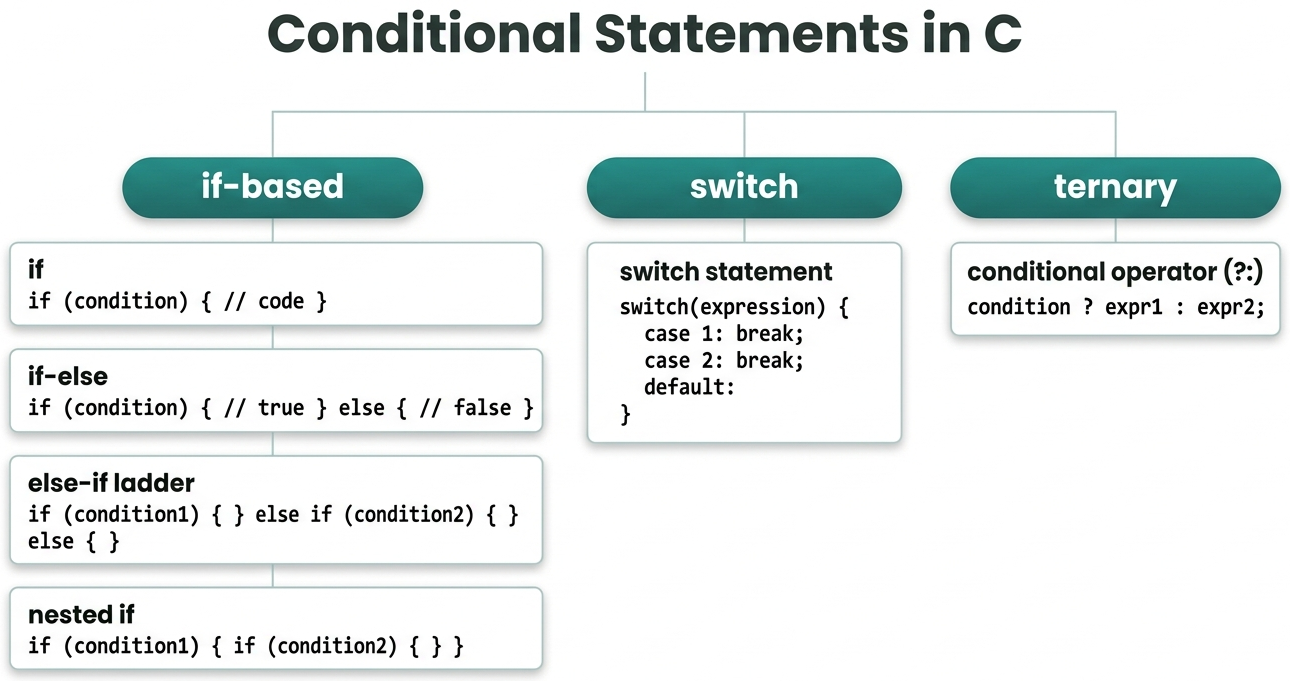
- The if Statement: The if statement executes a block of code only if the condition is true.
- The if-else Statement: It provides two paths, one if a condition is true and another if it is false.
- Nested if-else Statement: One if-else block can contain another if-else.
- Else-if ladder: This has a chain of conditions where each is tested one after another.
- The switch statement: It allows multiple possible execution paths based on the value of a single variable.
- Conditional/Ternary Operator (?:): It is the shorthand for a simple if-else statement.
The if Statement
The if statement is the simplest conditional statement in C. It allows to execute a block of code only when a specified condition is true. If the condition is false, the block is skipped, and the program continues with the next statement.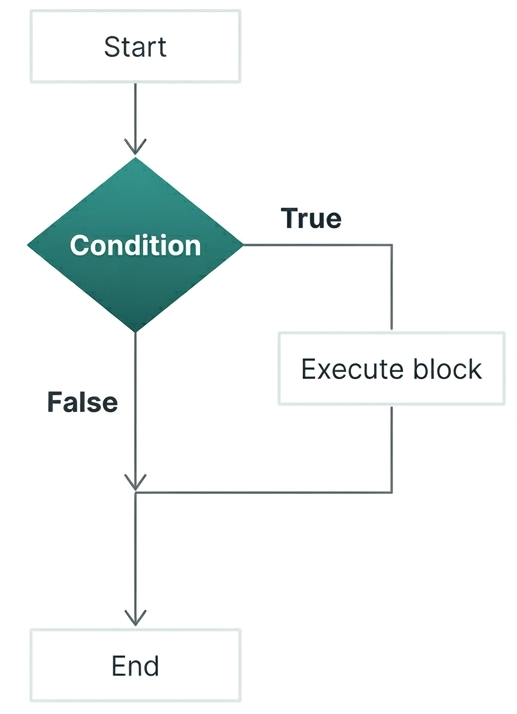
The if statement is best used for simple checks where you only need to run code when a single condition is satisfied.
Syntax:
Here,if (condition) {
// code to execute if condition is true
}
- condition: Any expression that evaluates to true (non-zero) or false (zero).
- If the condition is true, the code inside the block runs.
- If the condition is false, the block is ignored.
// C program to show if statement
#include stdio.h

// Main function
int main()
{
    int age = 20;

    if (age = 18)
    {
        printf("You are eligible to vote.\n");
    }

    printf("Program finished.\n");
    return 0;
}
Output:
Explanation:You are eligible to vote.
Program finished.
In this program, the message about voting eligibility is printed only because the condition age = 18 is true.
The if-else Statement
The if-else statement is used when you want the program to choose between two paths. If the condition is true, one block of code runs; if it is false, the other block runs.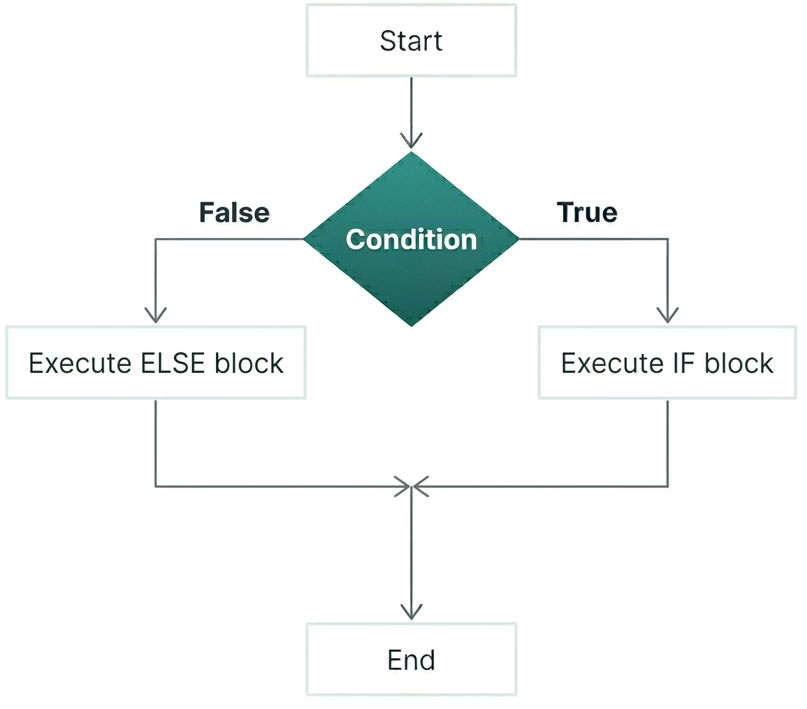
When to use:
Use if-else statement when there is a need to clearly define two alternatives, one if the condition is true and another if it is not.
Syntax:
Here,if (condition) {
// code to execute if condition is true
} else {
// code to execute if condition is false
}
- condition: Any logical expression that evaluates to true (non-zero) or false (zero).
- If the condition is true, the if block executes.
- If the condition is false, the else block executes.
// C program to show if-else statement
#include stdio.h

// Main function
int main()
{
    int number = 7;

    if (number % 2 == 0)
    {
        printf("The number is even.\n");
    }
    else
    {
        printf("The number is odd.\n");
    }

    return 0;
}
Output:
Explanation:The number is odd.
Here, the program checks if the number is even. Since the condition number %2 == 0 is false, the else block runs instead.
The switch Statement
The switch statement is used when one option needs to be chosen from many based on the value of a single variable or expression.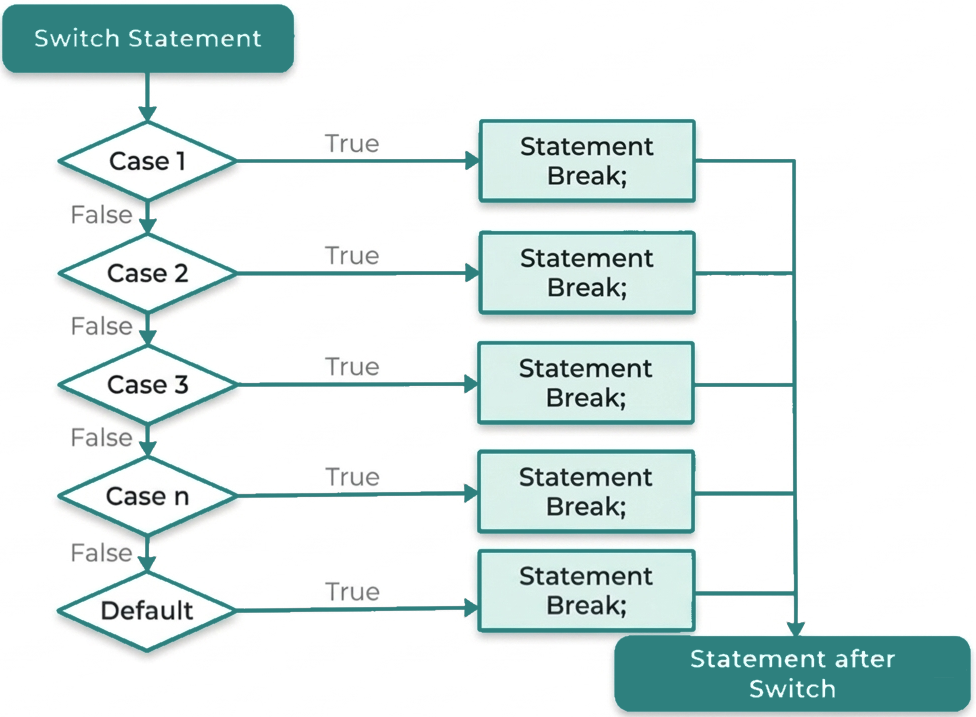
When to use:
When you need to compare the same variable against multiple values.
When there are many conditions, it can make the else-if ladder long.
When dealing with menus or a fixed set of choices.
Syntax:
Here,switch (expression) {
case value1:
// code to execute if expression == value1
break;
case value2:
// code to execute if expression == value2
break;
...
default:
// code to execute if no case matches
}
- expression: Must evaluate to an integer or character type.
- case value: Each case is compared with the expression. If they match, that block of code runs.
- break: Stops the switch block after a case executes, without it, execution “falls through” to the next case.
- default: Optional block that runs if none of the cases match.
// C program to show switch statement
#include stdio.h

// Main function
int main()
{
    int day = 3;

    switch(day)
    {
        case 1:
            printf("Monday\n");
            break;
        case 2:
            printf("Tuesday\n");
            break;
        case 3:
            printf("Wednesday\n");
            break;
        case 4:
            printf("Thursday\n");
            break;
        case 5:
            printf("Friday\n");
            break;
        case 6:
            printf("Saturday\n");
            break;
        case 7:
            printf("Sunday\n");
            break;
        default:
            printf("Invalid day\n");
    }
    return 0;
}
Output:
Wednesday
The Conditional/ Ternary Operator (?:)
The conditional operator is also known as the ternary operator, as it takes three operands: a condition, a value if the condition is true, and a value if the condition is false. It is a shorthand way of writing simple if-else statements.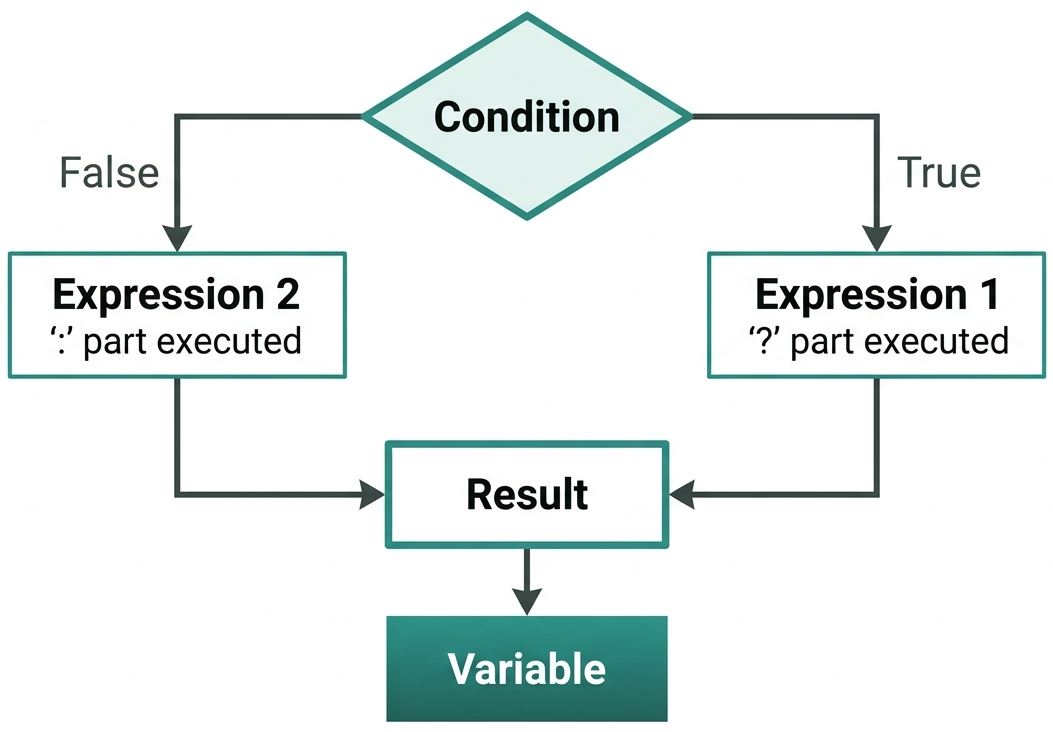
- It is used for simple decisions.
- When you want to make code concise.
- Avoid it for complex logics as it can reduce readability
Here,condition ? expression1 : expression2;
- condition: A logical expression that evaluates to true (non-zero) or false (zero).
- If the condition is true, expression1 is executed.
- If the condition is false, expression2 is executed.
// C program to show ternary operator
#include stdio.h

// Main function
int main()
{
    int number = 10;
    (number % 2 == 0) ? printf("Even\n") : printf("Odd\n");
    return 0;
}
Output:
Even
Common Pitfalls in Conditional Statements
Here are some common small mistakes that can lead to unexpected results:- Using = instead of ==: One of the most common errors is using the assignment operator (=) instead of the equality operator (==). The equality operator is used for comparison.
- Missing break in switch: Forgetting the break in switch causes fall-through, where multiple cases are executed unintentionally.
- Deeply Nested if-else: Writing too many nested if-else blocks makes code hard to read and debug.
- Overusing Ternary Operator: The ternary operator (?:) is concise, but it can become confusing if nested or used for complex logic.
- Ignoring Boundary Cases: Sometimes the conditions don’t handle the boundary values like = vs . This can cause problems in grading systems, ranges, or limit checks.
Conclusion
In conclusion, conditional statements in C enable dynamic behaviour instead of fixed sequences by allowing programs to make decisions and execute code selectively based on given conditions. With if, if-else, else-if, and switch, different scenarios can be handled effectively.Frequently Asked Questions
1. What are conditional statements in C?2. What is the difference between 'if' and 'if-else'?They are used to make decisions and execute code based on conditions.
3. When should we use 'switch' instead of 'if-else'?if runs code only when a condition is true, while if-else provides two execution paths.
4. What is the ternary operator in C?Use switch when checking a single variable against multiple fixed values.
5. What happens if a break is missing in a switch?It is a shorthand for if-else written as condition ? value1 : value2.
Execution continues to the next case, causing unintended behaviour.

0 Comments