Table of Contents
What are Constants?
Constants in Java are variables whose values cannot be changed once assigned. They are used to store fixed values such as PI, tax rates, or application settings.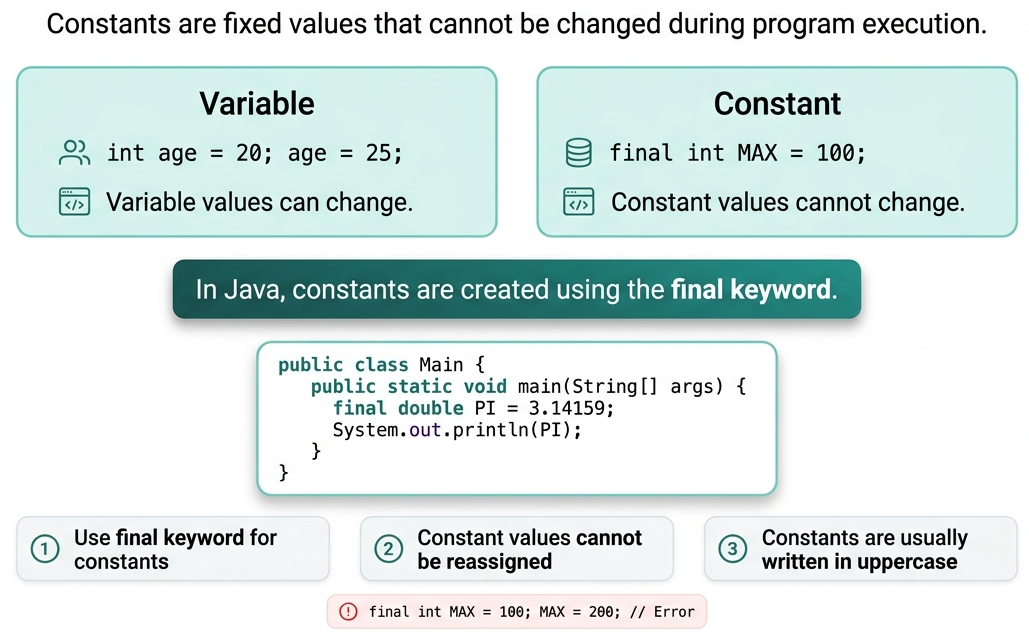
Why Use Constants?
Constants are used to improve code quality, maintain consistency, and make programs easier to manage and understand.
- Improves Readability: Using meaningful constant names like MAX_USERS or PI makes the purpose of a value clear at first glance. It helps developers quickly understand the code without needing extra explanations.
- Avoids Magic Numbers: Constants eliminate the use of random numbers such as 3.14 or 100 that appear without context. This makes the code cleaner, more structured, and easier to understand.
- Easy Maintenance: If a value needs to be changed, you only update it in one place instead of searching the entire code. This saves time and reduces the chances of mistakes.
- Enhances Safety: Constants prevent accidental modification of important values during program execution. They ensure that fixed values like limits or configurations remain unchanged.
- Promotes Code Reusability: Constants can be reused throughout the program wherever needed. This avoids duplication and keeps the code consistent across different parts of the application.
Declaration
Constants in Java are declared using the final keyword. When combined with static, the constant belongs to the class rather than an instance, making it globally accessible.Syntax:
Example:static final dataType CONSTANT_NAME = value;
// Java program to show constants
class ConstantsExample
{
    static final double PI = 3.14159;
    public static void main(String[] args)
    {
        System.out.println("Value of PI: " + PI);

    }
}
Output:
Value of PI: 3.14159
Naming Convention
Here are some rules for naming constants in Java:- Use Uppercase Letters: Constants are always written in uppercase letters so they can be easily identified in the code.
- Use Underscores for Separation: Separate multiple words using underscores (_) to improve readability (e.g., MAX_VALUE).
- Use Meaningful Names: Choose names that clearly describe the purpose of the constant, making the code self- explanatory.
- Avoid Abbreviations: Use full and descriptive words instead of short or unclear abbreviations to prevent confusion.
- Follow Consistent Naming Style: Maintain the same naming pattern throughout your project to keep the code clean and professional.
Enums as Constants
Enums (enumerations) are used when a variable can take a fixed set of values. They are a better alternative to multiple constants.Syntax:
Example:enum EnumName
{
VALUE1, VALUE2, VALUE3;
}
// Java program to show enum constants
enum Day
{
    MONDAY, TUESDAY, WEDNESDAY;
}

class EnumExample
{
    public static void main(String[] args)
    {
        Day today = Day.MONDAY;
        System.out.println("Today is: " + today);
    }
}
Output:
Today is: MONDAY
final vs finally vs finalize
Here is a difference between final, finally, and finalize:| Feature | final | finally | finalize |
|---|---|---|---|
| Definition | final is a keyword used to restrict modification of variables, methods, and classes. | finally is a block used in exception handling that always executes. | finalize() is a method used by the garbage collector before destroying an object. |
| Syntax | final int x = 10; | try { } finally { } | protected void finalize() { } |
| Usage | It ensures that the value cannot be changed once assigned. | It ensures important code (like closing resources) always runs. | It is used for cleanup operations before object destruction. |
| Execution | Applied at compile time. | Executes after try-catch block. | Called by JVM before garbage collection. |
| Modification | Does not allow modification. | Not related to modification. | Not used for restricting modification. |
Best Practices
- Always Use static final Together: Using static final ensures that constants are shared across all objects and remain unchanged. It also improves memory efficiency since only one copy exists.
- Group Constants in a Class: Keep all related constants in a separate class (like Constants.java). This makes your code more organized and easier to manage.
- Use Enums for Fixed Sets: When you have a fixed set of values (like days, states, or roles), use enums instead of constants. Enums provide better type safety and readability.
- Keep Constants Public if Needed: Use public static final when constants need to be accessed from different classes. This makes them reusable across the entire application.
- Use Meaningful and Consistent Names: Always name constants clearly using uppercase and underscores (e.g., MAX_LIMIT, DEFAULT_TIMEOUT). This helps other developers quickly recognize and understand their purpose.
Common Mistakes
- Forgetting the final Keyword: If you don’t use final, the variable can still be modified. This defeats the main purpose of creating a constant.
- Not Using Proper Naming: Constants should be written in uppercase (like MAX_SIZE, PI). Using lowercase or unclear names makes them hard to identify.
- Overusing Constants: Not every variable needs to be a constant. Only values that never change should be declared as constants.
- Using Hardcoded Values Instead: Writing values directly in the code instead of using constants makes it harder to manage. It reduces readability and increases the chance of errors.
- Poor Organization of Constants: Scattering constants throughout the code makes them difficult to find and update. It’s better to group them in one place (like a separate class or section).
Conclusion
Constants in Java play a crucial role in writing clean and maintainable code. By using final and static final, developers can ensure values remain unchanged and accessible. Along with enums and proper naming conventions, constants help reduce errors and improve readability. Following best practices and avoiding common mistakes can make your code more professional and efficient.Frequently Asked Questions
1. What is a constant in Java?2. Why do we use static final together?A constant is a variable whose value cannot be changed once assigned.
3. Can we change a final variable?To make the constant class-level and unchangeable.
4. What is the difference between enum and constant?No, once assigned, its value cannot be modified.
5. Is final method inherited?Enums represent a group of constants, while constants are single fixed values.
Yes, but it cannot be overridden in subclasses.

0 Comments