Table of Contents
Introduction to C Programming
C is often called a middle-level language because it combines the best of both worlds. It allows direct interaction with hardware like low-level languages while still offering structured programming capabilities.- C provides direct access to memory using pointers.
- Programs written in C are fast and efficient.
- The language has a simple and clean syntax.
- It forms the foundation for many modern languages like C++, Java, and Python.
- C is widely used in operating systems, compilers, and embedded systems.
Core Features of C Programming Language
Here are the major features that make C so powerful and widely used: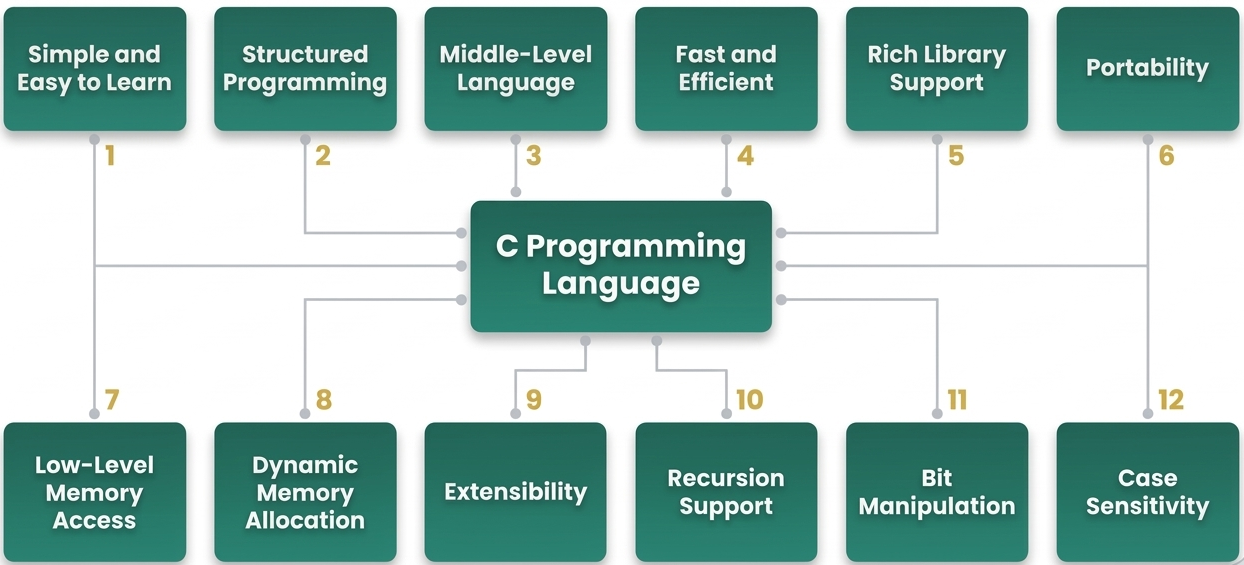
1. Simple and Easy to Learn
C has a relatively small set of keywords and a straightforward syntax. This makes it easier for beginners to start coding without feeling overwhelmed.- The language uses only a limited number of keywords.
- Syntax rules are consistent and predictable.
- Programs are written in a structured way.
- It encourages logical thinking and problem solving.
- Debugging becomes easier due to its simplicity.
2. Structured Programming Language
C follows a structured programming approach. Programs are divided into functions, making them easier to manage and understand.- Code is organized into functions or modules.
- Each function performs a specific task.
- It reduces code duplication through reuse.
- Improves readability and maintainability.
- Helps in debugging large programs effectively.
3. Middle-Level Language
C bridges the gap between high-level and low-level programming.- It supports high-level constructs like loops and functions.
- It also allows low-level operations like memory manipulation.
- Programmers can write system-level code efficiently.
- It provides flexibility for different types of applications.
- Suitable for both application and system programming.
4. Fast and Efficient
Performance is where C truly shines. Programs written in C run very fast compared to many modern languages.Minimal abstraction leads to faster execution.
- Direct access to memory improves speed.
- Compiled language produces efficient machine code.
- Low runtime overhead ensures better performance.
- Ideal for real-time systems and embedded applications.
5. Rich Library Support
C comes with a standard library that provides many built-in functions.Functions for input and output operations.
- Mathematical functions for calculations.
- String handling utilities.
- Memory allocation functions.
- File handling capabilities.
6. Portability
Programs written in C can run on different machines with little or no modification. Code can be compiled on different platforms.- Supports multiple operating systems.
- Makes software development more flexible.
- Saves time when moving projects across systems.
- Encourages platform-independent development.
7. Low-Level Memory Access
C provides powerful tools to work directly with memory. Pointers allow direct access to memory locations.- Memory allocation can be controlled manually.
- Enables efficient use of system resources.
- Important for system programming tasks.
- Helps in building operating systems and drivers.
8. Dynamic Memory Allocation
C allows memory to be allocated and freed during runtime. Functions like malloc, calloc, and free are used.- Memory is used only when required.
- Helps in handling large data efficiently.
- Reduces memory wastage.
- Essential for building flexible applications.
9. Extensibility
C allows programmers to extend its functionality. New functions can be added easily.- Libraries can be created and reused.
- Supports modular programming.
- Makes large-scale development easier.
- Encourages code reuse and scalability.
10. Recursion Support
C supports recursion, where a function calls itself. Useful for solving complex problems.- Simplifies code for mathematical computations.
- Reduces the need for complex loops.
- Commonly used in algorithms like factorial and Fibonacci.
- Helps in tree and graph-based problems.
11. Bit Manipulation
C allows operations at the bit level. Bitwise operators provide fine control.- Useful in embedded systems and hardware programming.
- Helps in optimizing performance.
- Reduces memory usage.
- Enables efficient data processing.
12. Case Sensitivity
C distinguishes between uppercase and lowercase letters. Variables like value and Value are different.- Helps avoid naming conflicts.
- Encourages clear coding practices.
- Requires attention while writing code.
- Improves precision in programming.
Advantages of C
- Strong Programming Foundation: C helps in understanding core concepts such as variables, loops, and memory. This makes it easier to learn other programming languages later.
- High Performance: C programs run very fast because they are close to the hardware. This makes it suitable for systems where speed is important.
- Efficient Memory Usage: C gives control over memory through pointers and dynamic allocation. This helps in using resources effectively.
- Portability: C programs can run on different platforms with minimal changes. This makes development flexible and time-saving.
- Wide Application Area: C is used in operating systems, embedded systems, and compilers. Its versatility makes it useful across many fields.
Conclusion
C has stood the test of time for a reason. It gives programmers unmatched control over hardware while still maintaining a structured approach to coding. What this really means is that once you understand C, picking up other languages becomes much easier.
Its speed, efficiency, and flexibility make it a go-to choice for systems programming and beyond. Even today, learning C is not just about the language itself, it’s about understanding how programming works at a deeper level.
Frequently Asked Questions
1. Why is C called a middle-level language?2. Is C still used today?C is called a middle-level language because it supports both high-level programming features like functions and loops, and low-level features like memory access using pointers.
3. What are the main features of C?Yes, C is still widely used in operating systems, embedded systems, compilers, and performance-critical applications.
4. Is C good for beginners?Some key features include simplicity, structured programming, portability, efficiency, pointers, dynamic memory allocation, and rich libraries.
5. What is the difference between C and C++?C is a great starting point because it builds a strong foundation in programming concepts and memory management.
C is a procedural language, while C++ supports object-oriented programming along with procedural features.

1 Comments