Table of Contents
Features of Java
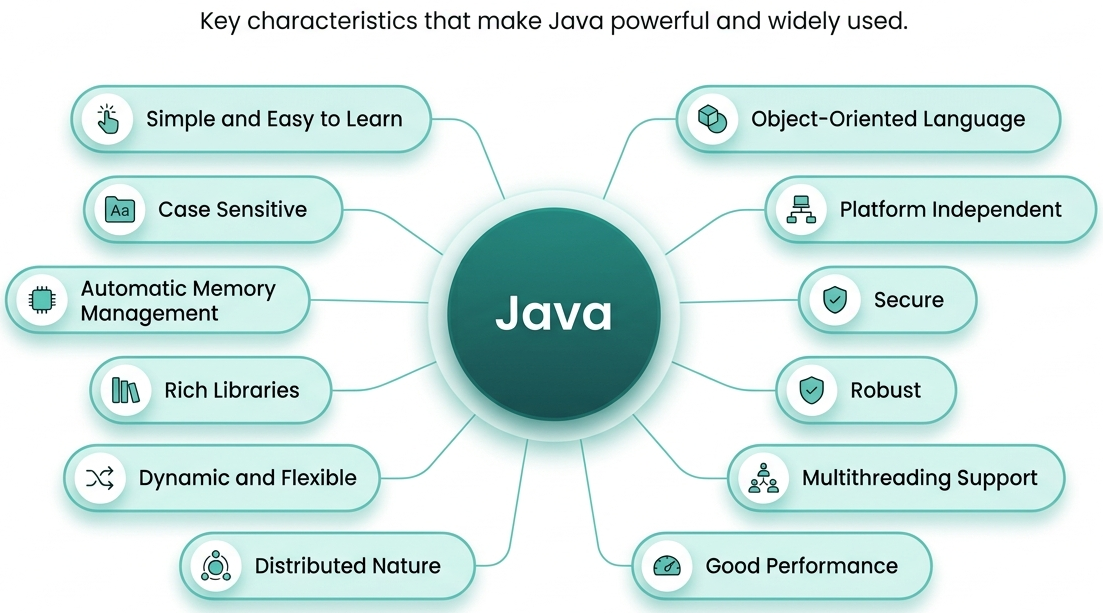
1. Simple and Easy to Learn
Java uses a clean and readable syntax that makes programming easier to understand for beginners.
- Java avoids complex features like pointers, which reduces confusion.
- The syntax follows a consistent and readable structure.
- Programs are written in an organized manner.
- Debugging requires less effort compared to many other languages.
Java uses object-oriented principles to create modular and reusable programs.
- Java organizes code using classes and objects.
- Inheritance allows developers to reuse existing code.
- Polymorphism enables multiple implementations of the same method.
- Encapsulation protects data by restricting access.
- Abstraction hides unnecessary details from the user.
Java allows programs to run on different systems without requiring changes to the code.
- Java converts source code into bytecode instead of machine code.
- The Java Virtual Machine (JVM) executes bytecode on any system.
- The same program runs on multiple operating systems.
- Developers do not need to rewrite code for different platforms.
Java provides a secure environment that protects applications from unsafe operations.
- Java does not use pointers, which reduces security risks.
- Bytecode verification checks code before execution.
- The runtime environment performs security checks.
- Java is suitable for web and network-based applications.
Java is designed to handle errors effectively and maintain stable execution.
- Java includes strong exception handling mechanisms.
- The compiler and runtime system detect errors.
- Automatic memory management reduces system crashes.
- Garbage collection removes unused objects from memory.
Java allows multiple tasks to run simultaneously within a single program.
- Java supports parallel execution of multiple threads.
- Tasks can run at the same time within one application.
- Multithreading is useful in real-time systems.
- CPU resources are utilized more efficiently.
Java delivers efficient performance through runtime optimizations.
- The Just-In-Time (JIT) compiler converts bytecode into machine code.
- Execution becomes faster during runtime.
- Java performs better than many interpreted languages.
- The language balances performance with safety.
Java supports applications that run across multiple systems connected through a network.
- Java includes support for RMI and socket programming.
- Applications can communicate across different machines.
- The language supports client-server architecture.
- Java is suitable for large-scale distributed systems.
Java allows programs to adapt and update during runtime.
- Classes can be loaded dynamically when required.
- Libraries can be updated without restarting the system.
- Java supports dynamic memory allocation.
- Programs can adjust to changing requirements.
Java provides a wide range of built-in libraries that simplify development.
- Java includes data structures such as ArrayList and HashMap.
- Libraries support file handling and networking operations.
- Developers can reuse pre-built components.
- Development becomes faster and more efficient.
Java manages memory automatically using a garbage collection system.
- The garbage collector removes unused objects.
- Memory leaks are reduced significantly.
- Developers do not need to manage memory manually.
- Programs become safer and more reliable.
Java treats uppercase and lowercase letters as different in identifiers.
- Variables like “Data” and “data” are treated as separate.
- Naming remains clear and consistent.
- Developers must follow proper naming conventions.
- Errors can occur if case is not handled carefully.
Advantages of Java
- Easy to Learn: Java provides a simple and structured syntax that allows beginners to understand programming concepts easily.
- Object-Oriented Approach: Java uses object-oriented principles that organize code into reusable and manageable components.
- Platform Independence: Java programs run on any system that has a Java Virtual Machine, which removes platform dependency.
- High Security: Java includes built-in security features that protect applications from unauthorized access and unsafe execution.
- Reliability and Stability: Java ensures stable program execution through strong error handling and automatic memory management.
- Wide Industry Usage: Java is used in Android development, web applications, and enterprise systems, which makes it highly valuable.
Conclusion
Java remains one of the most important programming languages because of its versatility and reliability. Features such as platform independence, security, and automatic memory management make it a strong choice for developers. Both beginners and experienced programmers use Java in a wide range of applications.A strong understanding of Java builds a solid programming foundation and makes it easier to learn other languages. For this reason, Java continues to be relevant in modern software development.
Frequently Asked Questions
1. What is Java?2. Why is Java platform independent?Java is a high-level programming language that is used to develop applications like websites, mobile apps, and software systems. It is known for its simplicity, security, and platform independence.
3. What is JVM in Java?Java is platform independent because it uses the Java Virtual Machine (JVM). The code is converted into bytecode, which can run on any system that has JVM installed.
4. What are the main features of Java?JVM (Java Virtual Machine) is a system that runs Java programs. It converts bytecode into machine code so that the program can be executed on any device.
5. What is Object-Oriented Programming in Java?Some important features of Java are object-oriented programming, platform independence, security, multithreading, and automatic memory management.
6. What is the difference between Java and C?Object-Oriented Programming (OOP) is a concept where programs are based on objects and classes. It helps in writing reusable and organized code.
7. Is Java good for beginners?Java is object-oriented and platform independent, while C is a procedural language and is closer to hardware. Java also provides automatic memory management, while C requires manual memory handling.
8. What is Garbage Collection in Java?Yes, Java is a good choice for beginners because it has simple syntax and helps in building strong programming concepts.
9. Where is Java used?Garbage Collection is a feature in Java that automatically removes unused objects from memory. This helps in managing memory efficiently.
10. What is JIT Compiler in Java?Java is used in many areas such as Android app development, web applications, desktop software, and large enterprise systems.
JIT (Just-In-Time) compiler improves the performance of Java programs by converting bytecode into machine code during runtime.

0 Comments