In this article, we will discuss the features of Python and understand why it is the most popular programming language.
Table of Contents
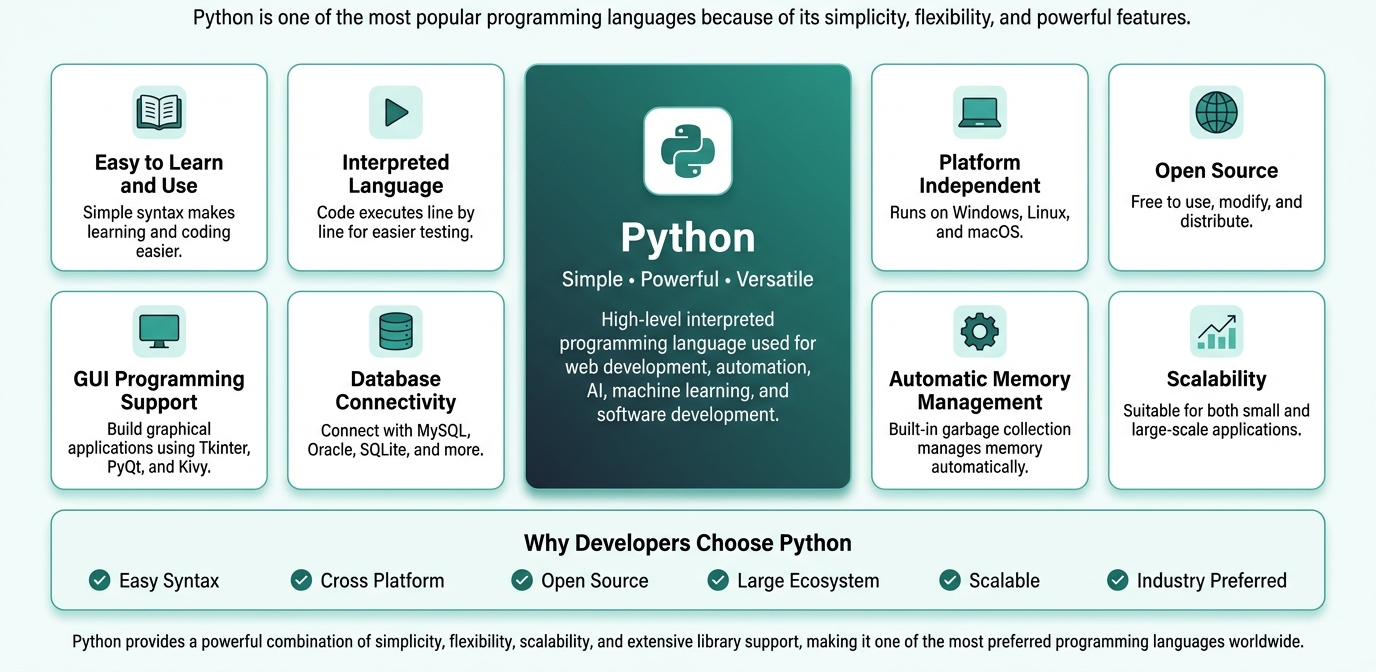
Features of Python
- Easy to Learn and Use: Python has a simple and beginner-friendly syntax, which helps beginners to learn it easily with little difficulty, and also it is also helpful for developers to write programs efficiently.
- Interpreted Language: Python is an interpreted language, which means the code is executed line by line. This allows developers to test their programs quickly and also makes debugging easier.
- Platform-Independent: Python is a platform-independent programming language, which means it can be accessed and used in any operating system like Linux, Windows, and macOS without any major changes in the code.
- Open-Source: Python is an open-source programming language, which means it is free to use; developers can access, use, and modify Python according to their requirements.
- GUI Programming Support: Python supports graphical user interface (GUI) development using libraries such as Kivy, Tkinter, and PyQt so that developers can create applications with an interactive interface.
- Database Connectivity: Python can easily connect to databases such as Oracle, MySQL, and SQLite, which helps developers manage, store, and retrieve data efficiently.
- Automatic Memory Management: Python automatically manages memory using a built-in garbage collector, which reduces memory-related issues and makes the system faster and more efficient.
- Scalability: Python is suitable for small or large projects. Many companies use Python to handle large amounts of user data.
- Extensible and Embeddable: Python can easily integrate with other programming languages such as C and C++ and can also be embedded into software applications for scripting purposes.
- Versatile Language: Python is also used in multiple fields such as artificial intelligence, web development, software development, machine learning, automation, and cybersecurity.
Conclusion
Python provides many important features that make it one of the most preferred programming languages in the world. Its simple syntax, platform independence, large library support, and versatility help developers build efficient and scalable applications. Even if a beginner is learning programming or a professional is working on advanced technologies or programs, Python offers the tools required for modern software development.Frequently Asked Questions
1. What makes Python different from other programming languages?2. Does Python support object-oriented programming?Python is different because of its simple syntax, readability, and wide range of applications. It allows developers to write programs using fewer lines of code.
3. Why is Python called an interpreted language?Yes, Python supports object-oriented programming concepts such as classes, objects, inheritance, and polymorphism.
4. Can Python be used for automation?Python is called an interpreted language because the code is executed line by line by the Python interpreter instead of being compiled all at once.
5. Which industries use Python?Yes, Python is widely used for automation tasks such as file handling, web scraping, email automation, and task scheduling.
Python is used in industries such as software development, artificial intelligence, cybersecurity, finance, healthcare, and data science.
Is Python suitable for large-scale applications?
Yes, Python is suitable for both small and large-scale applications because of its scalability and strong library support.

2 Comments