When models designed through research transition into product development, one thing becomes clear right away: How do you make a generic model perform well at your particular task? The two dominant methods for this are fine-tuning, when the model is retrained on your custom dataset, and Retrieval-Augmented Generation (RAG), where the model receives relevant data at the time of query. Both of these solutions address the "generic model and specific problem" issue in fundamentally different ways, with their own strengths and weaknesses and use cases. Picking an inappropriate method will likely lead to wasted developer effort, sky-high infrastructure costs, and possibly even an underperforming product. In this article, both methods are covered in detail, outlining their pros and cons and helping you pick the best option for your use case.
Table of Contents
What is Fine-Tuning?
The fine-tuning of the machine is the technique that involves training the pre-existing model further with the help of specific or contextual data in order to enable the model to develop the desired behavior, tone, or knowledge. The information is obtained without any external lookup but is stored directly in the form of the model’s internal parameters or weights, making the knowledge permanent. This process is especially effective when used for developing the desired behavior rather than learning facts. It is like training an employee until he/she knows everything instinctively.
- Changes the Model Itself: Training changes the parameters of the model, resulting in an altered response pattern.
- Increases Domain Knowledge: The model increases its knowledge of particular subject matter or terms through training.
- Controls the Output: Output can be made to adhere to a certain style or structure.
- Results in a Permanent Change: The model gains permanent knowledge and skills from training.
- Needs Labeled Data: Examples are necessary for training to achieve the desired output.
What is RAG?
In Retrieval-Augmented Generation, a language model uses an external knowledge source to retrieve relevant documents or data and to generate a response on its basis. Rather than relying only on the information that was provided during the training process, RAG gives the possibility to the model to "look up something," similarly to how a person uses a reference to answer a question. The greatest advantage of such an approach is the ability to keep answers grounded in up-to-date information without having to retrain the model at all. In this sense, the model separates "reasoning ability" from "factual knowledge."
- Real-time Knowledge Retrieval: Relevant documents are retrieved from an external source and provided to the context of the model prior to generating a response.
- Dynamic Generation: The model can generate responses based on the most recent information rather than based on what it was trained on.
- No Retraining Required: The updates happen via updating the knowledge base rather than via retraining the underlying model.
- Responses Based on Evidence: The retrieved documents provide evidence for the answers, which minimizes the chances of the model inventing facts.
- Need for a Retrieval Pipeline: A vector database, embeddings, and search mechanisms are required to find relevant context.
How Does Fine-Tuning Work?
Fine-tuning alters the structure of the model via an organized additional learning process that takes place completely before any deployment. The process begins by taking an already created foundational model and then gradually changing its behavior through the introduction of new data sets. At each stage of the process, the goal is to ensure that the model really improves at the target task without compromising its abilities.
- Choose a Pre-trained Model: Choose a base model that is capable enough in general to fulfill your application needs.
- Collect Task-relevant Data: Prepare a dataset related to your task and eliminate noise from that dataset.
- Fine-tune the Model: Train the weights of the model using the collected data through supervised learning.
- Measure Performance Improvement: Measure the performance improvement of the fine-tuned model.
- Use the Fine-tuned Model: Deploy the fine-tuned model into production use.
How Does RAG Work?
RAG improves the reaction of the system by providing relevant information on-the-go, right after a query is generated, and not by depending on the information that was known before by the model. This is a live process that occurs each time a user asks for something from the system. In all of these steps, the objective is to extract the most relevant context to make sure that the model generates a grounded answer.
- Receive User Query: The process starts with the submission of a prompt or question by a user.
- Convert the Query to Embeddings: The query is converted to a vector for a similarity search.
- Retrieve Relevant Documents: The vector database is searched for the most relevant chunks of data.
- Inject the Context into the Prompt: The extracted documents are added to the initial query and sent to the model.
- Generate the Grounded Response: The answer is generated by the model based on the information and context provided.
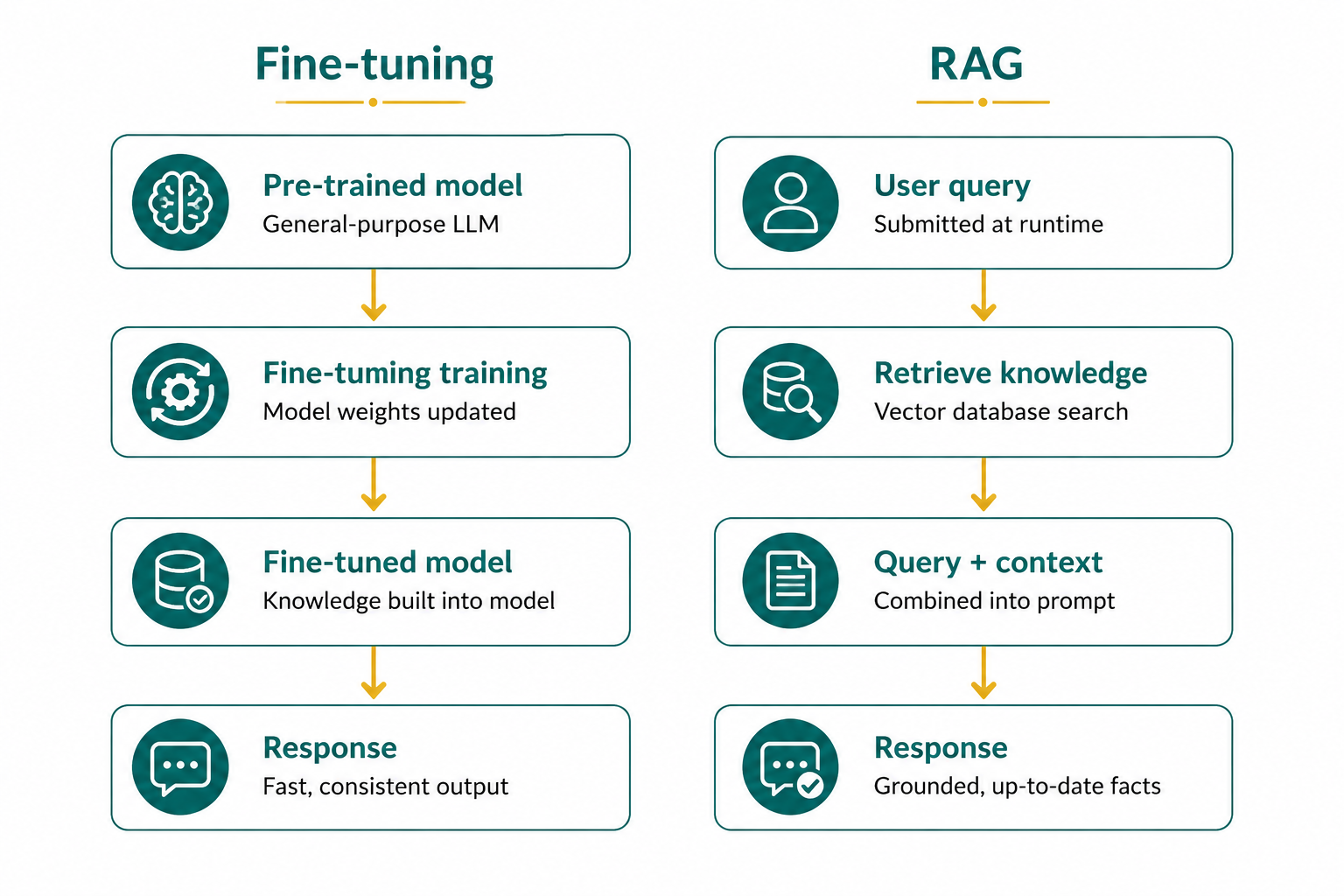
Fine-Tuning vs RAG
Seeing the two approaches side by side makes the trade-offs much clearer, especially when it comes to cost, flexibility, and how each handles changing information. The table below summarizes the core differences across the factors that matter most when making a decision.
| Factor | Fine- Tuning | RAG |
|---|---|---|
| Primary purpose | Specializes in model behavior. | Provides external, up-to-date knowledge. |
| Model weights | Model weights are updated through training. | Model weights remain unchanged. |
| Knowledge source | Knowledge is stored inside the model. | Knowledge is retrieved from an external database. |
| Training required | Yes, extensive training is required. | No, Specific training is not required. |
| Handling recent information | Reflection of information is limited without retraining. | Excellent as it reflects updates instantly. |
| Development cost | Higher development cost. | Moderate development cost. |
| Inference cost | Usually lower after deployment. | Slightly higher due to the retrieval step. |
| Implementation complexity | Implementation requires a training pipeline. | Implementation requires a retrieval pipeline. |
| Response consistency | Response consistency is very high. | Response depends on the quality of the retrieved documents. |
| Knowledge updates | Knowledge updates require retraining. | Simply update the knowledge base. |
| Best for | Used for domain expertise and consistent behavior. | Used for frequently changing, fact-heavy information. |
Advantages of Fine-Tuning
The value of fine-tuning comes clearly through when the intention is to use fine-tuning to teach a model new skills, tone, or domain reasoning. This creates cumulative gains over time because the properly fine-tuned model will not need as much prompt engineering and correction in practice. In the case of businesses that have clear use cases, the result is improved user experience and efficiency.
- Increased Accuracy on Specialized Tasks: The model consistently outperforms in the specific domain in which it was fine-tuned.
- Consistent Style and Tone: The output remains consistent, which is critical for brand consistency and business communication.
- Increased Domain Knowledge: The model is familiar with specialized vocabulary that is uncommon in generic datasets.
- Decreased Response Time: No retrieval is needed in response generation because the knowledge is embedded in the model.
- Improved Personalization: The model is capable of being customized according to business requirements and communication style.
Advantages of RAG
The advantages of using RAG include applicability when it comes to cases that require timely, up-to-date, and easily maintainable information. The fact that information is stored outside the model makes it possible to keep the system updated without retraining. This makes it suitable for organizations that require agility and timely updates.
- Access to the Latest Information: Updated documents are readily accessible by the model without undergoing retraining.
- Reduction in Misinformation: Using retrieved evidence reduces the chance of giving incorrect information.
- Easy Maintenance: It is easier to update a knowledge base rather than retrain the whole model.
- Scalability in Knowledge Management: RAG can scan through millions of documents without increasing the size of the model.
- Cost Savings: No costly retraining is required in the long run.
Limitations of Fine-Tuning
Even though fine-tuning has several advantages, there are certain limitations related to this approach, which should be taken into consideration prior to choosing fine-tuning as a model improvement method. Such problems will surprise many teams, as people will not take into account all the necessary data and skills required for this process.
- High Cost of Training: Additional training will cost money and infrastructure, such as GPUs.
- Static Knowledge: The model will not be able to learn about new information that is released after the training is over.
- Problem of Overfitting: Incorrect or unrepresentative datasets may negatively affect the generalization of the model.
- Time-consuming Development Process: The process of preparing datasets, training, and evaluating the model may take from days to weeks.
- Maintenance Costs: Any update in knowledge means another training process.
Limitations of RAG
While RAG provides flexibility, it also brings along a list of its own technical hurdles that might negatively impact performance if not properly handled. As the system is entirely dependent on what it retrieves, the drawbacks of retrieval would be seen in the answer itself. Teams implementing RAG should consider the quality of their documents and search infrastructure as a key part of the solution.
- Problems Associated With Retrieval Quality: The poor or irrelevant results obtained through retrieval will make the answer incorrect or uninformative.
- Increased Latency: Additional latency comes from searching and retrieving documents in contrast to an entirely fine-tuned model.
- Complexity in Infrastructure: There is a requirement for vector databases, embedding models, and a search infrastructure that needs to be built.
- Dependence on Documents Available: Information cannot be retrieved if it doesn't exist in the knowledge base.
- Issues With Chunking: The improper segmentation of documents impacts retrieval quality and leads to context incompleteness.
Factors to Consider Before Choosing an Approach
A choice between fine-tuning and RAG has to be based on technical and business factors, not on the popularity of these approaches at the moment. Going through a list of vital questions will help you avoid many issues in the future. The criteria below comprise all factors that have to be taken into account.
- Nature of Your Data: Determine whether your data is volatile or static.
- Budget: See if you have enough budget for training and GPU resources to train the model.
- Maintenance Capabilities: Determine how often your knowledge base is updated and who will take care of that.
- Performance: Find out which factor is more important for your application — proper behavior or factual accuracy.
- Infrastructure Capabilities: See if your team is able to build and maintain vector databases and pipelines.
When Should You Choose Fine-Tuning?
Fine-tuning is the better option when your goal is to control how the model behaves rather than what it knows. Fine-tuning is particularly suitable when you want the model to maintain tone, structure, or domain-specific reasoning that does not need frequent adjustments. When your use case involves stable patterns as opposed to changing facts, fine-tuning will provide you with more predictable results.- Applications for Medical AI: Properly understanding and using clinical terminology for diagnosis or documentation purposes.
- Legal Document Creation: Writing contracts or legal documents with precise and consistent legal language.
- Writing According to Brand Guidelines: Writing all customer-facing texts in accordance with the company's unique tone of voice.
- Learning proprietary coding style: Following the coding styles and standards of a particular organization.
- Consistent Customer Support: Generating customer support messages that comply with the organization's policies.
When Should You Choose RAG?
In cases where the most important requirement is accuracy, and where the knowledge base is constantly changing, RAG is the more appropriate choice. This method excels in cases where it would be infeasible to keep retraining the model whenever the knowledge becomes outdated. If your application requires you to stay up-to-date, whether this means referring to documents, databases, or constantly evolving knowledge, then RAG keeps you updated without requiring you to constantly retrain.
- Tools for Enterprise Search: Assisting your employees to easily access and search through internal documentation.
- News and Current Events Applications: Answering questions based on the newest available information.
- Knowledge Bases Within Companies: Making sure that your policies, manuals, and procedures stay up-to-date.
- Research Assistants: Searching through large bodies of literature.
- Technical Documentation Lookup: Accessing accurate documentation for products or APIs.
Can Fine-Tuning and RAG Be Used Together?
Fine-tuning and RAG are not necessarily mutually exclusive methods since the best-performing models of AI generation actually use both of them. While fine-tuning makes the model exhibit a certain behavior, reasoning, and communication, RAG gives it correct and up-to-date information. In other words, the team is able to benefit from both methods by building a model that acts the way it should and also stays updated.
- Behavior + Knowledge: While the method of fine-tuning sets the way the response is built, RAG always updates the facts.
- Higher Accuracy: When using both methods, the model reduces hallucinations and improves domain knowledge.
- Consistent Communication Style: The facts keep changing, but the communication style remains consistent.
- Scalability: Changes in the knowledge database do not imply a need to fine-tune the model again.
- Enterprise-level Architecture: The right solution for customer service, legal assistants, healthcare, and research.
Best Practices for Fine-Tuning and RAG
Adhering to such discipline ensures that whatever technique (or their combinations) you select proves most effective. In fact, many unsuccessful applications of AI can be attributed to non-adherence to certain practices of data preparation, evaluation, or maintenance, not to selecting an inappropriate technique. The set of practices listed below is relevant for both techniques equally.
- Use Good-quality Data: Regardless of whether you train your model or develop a knowledge base, good-quality and well-structured data will produce better results.
- Validate Before Deploying: Test the fine-tuned models and check the accuracy of RAG retrieval before deployment.
- Measure and Evaluate: Monitor accuracy and relevance constantly and make changes to either training data or retrieval configuration if required.
- Optimize Document Chunking for RAG: Break down source documents into proper chunks.
- Update Wisely: Retrain the fine-tuned models only when necessary; update RAG knowledge bases often.
Conclusion
Fine-tuning and RAG are complementary methods instead of competitive technologies. While fine-tuning can be applied to cases that need specialized behavior, domain expertise, and output consistency through changes made in the model itself, RAG is best applied to cases that need accurate and updated facts through retrieval without changing any of the parameters of the model. It all depends on what you need from your AI application, based on your case. You have to consider the frequency of change in your knowledge, customization needs, budget constraints, and maintenance abilities in order to make a proper decision regarding which method should be applied.
Frequently Asked Questions
1. Is RAG cheaper than fine-tuning?
Generally, yes. RAG avoids the compute-heavy training process, though it still requires ongoing infrastructure for the vector database and retrieval pipeline, so costs aren't zero.
2. Does RAG eliminate the need for fine-tuning entirely?
Not necessarily. RAG is excellent for supplying facts, but if you need the model to consistently behave, reason, or communicate in a specific way, fine-tuning still adds value.
3. Which approach reduces hallucination more effectively?
RAG typically reduces factual hallucination better since responses are grounded in retrieved documents, while fine-tuning is more effective at reducing inconsistency in tone or structure.
4. Can small teams realistically implement RAG?
Yes. RAG has a lower barrier to entry than fine-tuning since it doesn't require training infrastructure — just a well-organized knowledge base and a retrieval setup.
5. How do I know if my use case needs both fine-tuning and RAG?
f your application needs both a consistent, specialized voice and access to frequently changing facts, a hybrid approach combining both techniques is usually the most effective solution.

0 Comments