Understanding its history helps you see why C is still relevant today and why it continues to be taught to beginners.
Table of Contents
Why Learning C History Matters?
- Foundation of modern languages: Languages like C++ and Java are heavily inspired by C.
- Core programming concepts: C teaches memory management and structured programming.
- Still widely used: It is used in operating systems, embedded systems, and compilers.
Key Facts About C Language
| Features | Detail |
|---|---|
| Developer | C was developed by Dennis Ritchie. |
| Organization | It was created at Bell Labs. |
| Year of Development | It was developed in the year 1972. |
| Purpose | It was created to develop the UNIX operating system. |
| Type of Language | It is considered a middle-level programming language. |
Early Background: Before C Existed
Before C was developed, programmers faced serious challenges while writing software.Machine Language
- Very low-level: Programs were written in binary instructions (0s and 1s).
- Difficult to manage: Writing and debugging programs was extremely complex.
Assembly Language
- Slight improvement: Used symbolic codes instead of binary.
- Hardware dependent: Programs could not run on different machines.
Early High-Level Languages
- Example: FORTRAN was mainly used for scientific calculations.
- Limited system control: These languages were not suitable for building operating systems.
Birth of C Programming Language
C was developed in the early 1970s by Dennis Ritchie at Bell Labs.Purpose Behind Creation
- Improvement over B language: The B language lacked data types and advanced features.
- Need for better system programming: Developers required a language that could handle complex systems efficiently.
What Made C Unique?
- Middle-level nature: It supports both low-level memory access and high-level programming features.
- Efficiency: Programs written in C run very fast.
Why C Was Created?
Now here’s the turning point. C was mainly created to develop the UNIX operating system.Problems with Earlier Approach
- Assembly-based development: UNIX was initially written in assembly language.
- Difficult maintenance: Making changes was slow and complex.
How C Changed Everything?
- Rewriting UNIX in C: This made the operating system portable.
- Better structure: Code became easier to read and maintain.
- Faster development: Developers could build systems more efficiently.
Evolution and History of C Programming Language
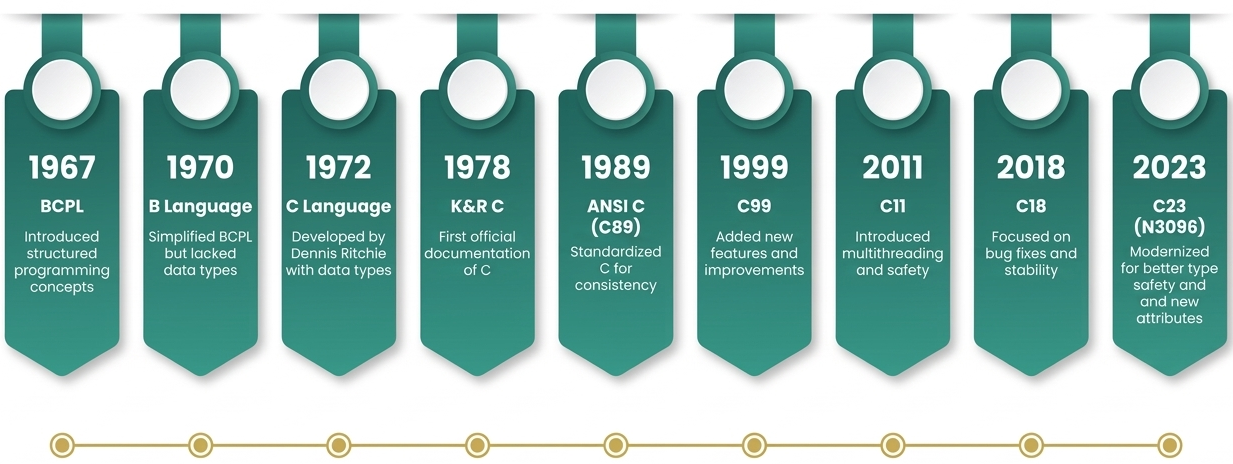
Let’s clearly understand how C evolved step by step.| Year | Stage | Explanation |
|---|---|---|
| 1967 | BPCL | BCPL introduced structured programming concepts that later influenced the development of B and C languages. |
| 1970 | B Language | The B language simplified BCPL but lacked data types, which limited its ability to handle complex programs. |
| 1972 | C Language | Dennis Ritchie developed C by adding data types and powerful features, making it more practical and efficient. |
| 1978 | K&R C | The book by Kernighan and Ritchie defined C syntax and usage, acting as the first standard reference. |
| 1989 | ANSI C (C89) | ANSI standardized C to ensure programs would work consistently across different systems. |
| 1999 | C99 | This version introduced new features like inline functions, new data types, and improved precision. |
| 2011 | C11 | C11 added multithreading support and improved safety features for modern computing needs. |
| 2018 | C18 | C18 focused on fixing issues and improving the stability of the language without major new features. |
Understanding the Evolution
From BCPL to B
- Simplification: B was created to make BCPL easier to use.
- Limitation: It lacked important features like data types.
From B to C
- Major improvement: C introduced data types like int and char.
- Better control: It allowed efficient memory management.
Standardization Phase
- Consistency: ANSI C ensured uniform behavior across systems.
- Global adoption: Developers worldwide started using C reliably.
Modern Updates
- Performance improvements: New features enhanced speed and usability.
- Safety features: Reduced errors and improved reliability.
Impact of C on Modern Programming
C has had a massive influence on modern programming.Influence on Other Languages
- C++: Builds on C by adding object-oriented programming.
- Java: Uses syntax similar to C.
- Python: Internally implemented using C.
Major Contributions
- Structured programming: Encouraged modular and readable code.
- System programming: Enabled development of operating systems and compilers.
- High performance: Allowed efficient use of system resources.
Features That Made C Popular
- Simplicity: Compared to assembly language, C is much simpler.
- Efficiency: Programs run close to machine speed.
- Portability: Code can run on multiple systems.
- Flexibility: Suitable for both system and application programming.
- Rich Standard Library: Makes development faster and easier.
Conclusion
The history of C programming language shows how a practical solution turned into a global standard. C solved the problem of portability while maintaining performance, which made it widely accepted.Frequently Asked Questions
1. Who developed the C programming language?2. Why is C important?C was developed by Dennis Ritchie at Bell Labs.
3. What is ANSI C?C made software portable and influenced many modern programming languages.
4. Is C still used today?ANSI C is the standardized version introduced in 1989 to ensure consistency.
5. What language came before C?Yes, it is widely used in operating systems and embedded systems.
C evolved from the B language, which was influenced by BCPL.

4 Comments