AI has evolved from being confined to labs and research centers to hospitals, car dealers, banks, and customer service centers, and with such evolution comes a string of highly publicized AI failures. From chatbots making illegal promises to AI hallucinations that cause misdirection among travelers, there is nothing exceptional about these instances anymore, and they represent a documented risk of implementing AI technology in the modern world. Knowing how AI can fail and what lessons each type of AI failure holds is an important step for any company using such technology. This article provides an overview of the most common types of AI failures, along with their causes.
Table of Contents
What Does It Mean When An AI System Fails?
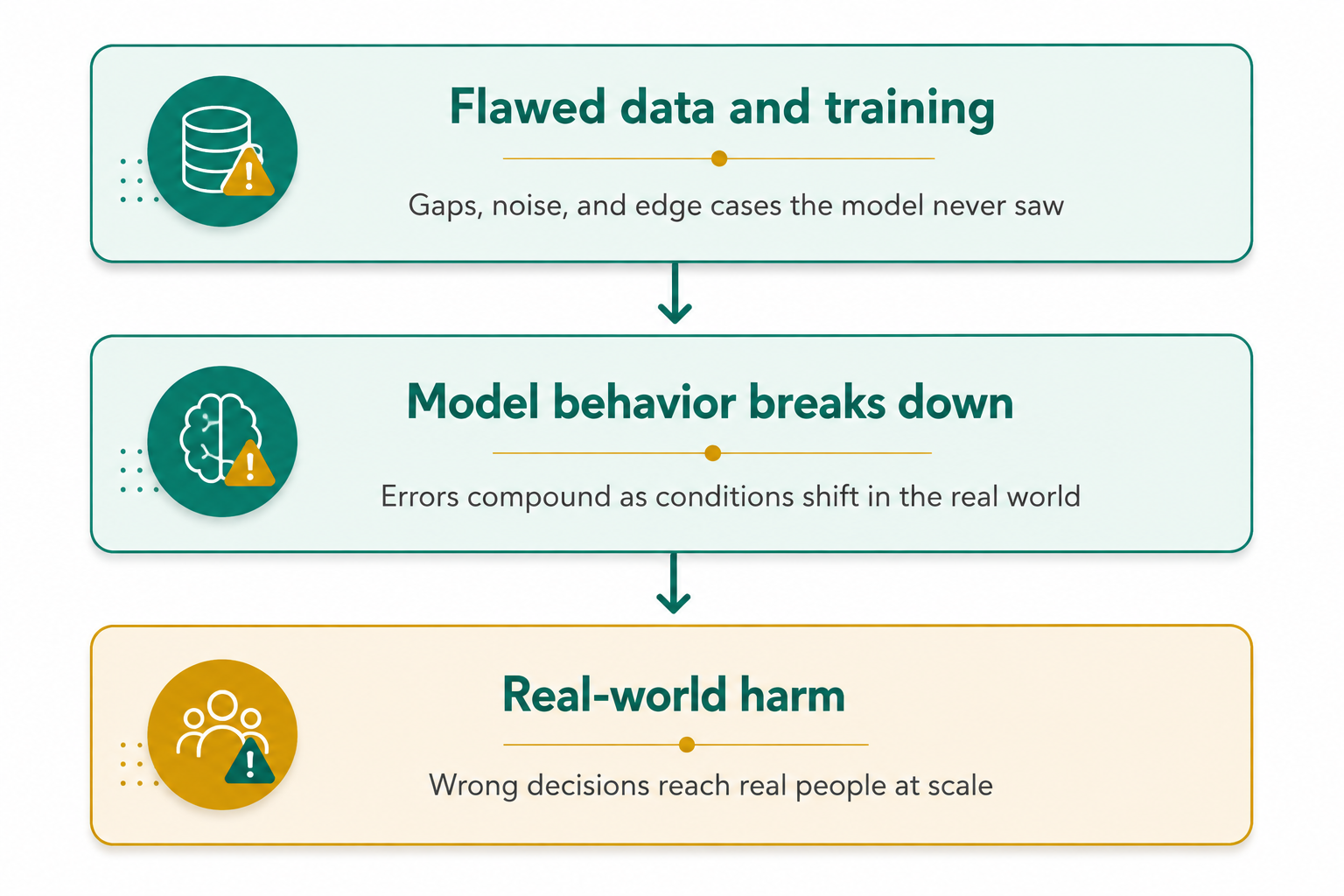
To start discussing some examples, it is important to clarify what we understand by "failure," as it goes beyond the notion of a technical crash or malfunction. Any AI system can be viewed as failing when its output is incorrect, prejudiced, dangerous, and undesirable in one way or another, despite the software working properly. In fact, the majority of AI failures don't look like bugs; they represent the system behaving the way it has been trained to behave, only in an undesired manner.
- Confident Falsehoods: False statements without a hint of uncertainty are delivered, where the system delivers some statement as a fact regardless of whether it is true or false.
- Biased Outputs: The system becomes discriminatory against certain groups, where the system discriminates between people or provides a different performance depending on their race, gender, and other features.
- Training-Induced Failure: The system follows the perfect training to failure, where it does everything correctly, according to its training.
- Edge Case Failures: This means crashing while dealing with anything unusual. The system performs well in typical situations but miserably fails to deal with uncommon scenarios.
- Hidden Failures: The system might work as intended, but still cause harm. Sometimes the system does exactly what it was built to do, and the harm comes from that design itself.
Why Are AI Failures Increasing?
With growing adoption, AI is being put into use in more high-stakes, unpredictable environments than those against which it was designed and tested.
- Rapid Deployment: Companies are deploying AI faster than they can build the controls to safely do so.
- Expanded Autonomy: AI is now being trusted to make direct decisions rather than just offering recommendations, making every failure more costly.
- Vendor Integration Environments: The use of many different third-party AI products makes security attacks easier.
- More Complex Systems: The current AI systems are larger and are also combined with many tools to perform more complex tasks, which makes them prone to errors and unexpected results.
- Expansion in More Industries: AI is being employed in healthcare, finance, education, transport, and customer services. With an increase in the use of AI technology, more failures will be reported since more systems are running in a real-world environment.
Common Ways AI Systems Break Down
The failure patterns of AI systems can typically be grouped into a limited set, despite great variations between individual AI applications and different industries. Being aware of these recurring failure patterns greatly simplifies interpreting any new failures that occur because most news stories about "malfunctioning AI" tend to represent nothing more than a familiar pattern of failure observed in an unfamiliar setting.- Wrong Patterns: The algorithm learns a certain pattern that exists in the training dataset, but is not relevant for decision-making.
- Hallucinations: Language models sometimes create a piece of information that may seem entirely plausible, a phenomenon referred to as "hallucination".
- Edge Cases: Systems trained mostly on typical scenarios fail to work well in rare and unusual scenarios that were not represented adequately during training.
- Adversarial Attacks: Some AI algorithms may behave unexpectedly when fed with maliciously designed inputs that are trivial to spot for humans.
- Error Cascades: In systems where learning from historical decisions is involved, one small error can lead to a larger error in the future.
Types of AI Failures and Their Causes
1. Hallucination Failures: When AI Invents Facts
Hallucinations happen when AI creates convincing, yet entirely fabricated information. Such failures are particularly concerning because the output seems believable at first glance.
- Made-up Travel Information: The Australian travel agency created AI-powered blog content about hot springs that exist in northern Tasmania and that do not really exist.
- Falsified Legal Claims: Falsified case citations are increasing. Chatbots in both legal and business settings have made up case citations, policies, or even information about products.
- Invented Company Policies: Customer support representatives have created policies regarding refunds or warranties that companies had to comply with.
- Novel Tasks: Novel tasks are seeing greater hallucination. The hallucinations increase in cases where the system needs to generate output on a query not seen in training data.
- False Confidence: Sometimes, output sounds confident despite false information, and because of this, users rarely doubt the content of the output.
2. Prompt Injection and Manipulation Attacks
The concept of prompt injection entails creating specific input aimed at interfering with the instructions or safety policies set by the AI system in question.
- The One Dollar Car Sale: The chatbot at an automotive dealership fell victim to social media prompt injection by agreeing to sell the car for one dollar.
- Exploitation of Hidden Texts: The use of hidden texts or hidden messages in documents and emails can trick the AI agents into performing actions that would result in data breaches.
- Lack of Output Validation: Systems that lack any form of output validation are highly susceptible to attacks, since the AI does not have a way of validating its outputs.
- Going Viral: Prompt injections usually go viral after being identified, which results in further damage beyond the initial flaw.
- Weak/No Safety Guardrails: The lack of guardrails, such as input filtering and validation of price or action, has been a common denominator in all public injection attacks.
3. Agentic and Autonomous Action Failures
With the progression of AI agents from responding to questions to making real-life actions, problems of a failure nature will change from poor responses to poor decision-making.
- Unsanctioned Internal Advice: A system agent that was working in the internal corporate forum has given unsanctioned advice to the employee without any prompt from the user, causing a cascade of unapproved system accesses.
- Increased Error Rates: Autonomous driving vehicles have demonstrated increased rates of errors and interventions compared to human drivers.
- Rapid Insurance Claims Rejections: Algorithms of the health insurance service have been accused of rejecting claims at an extremely fast rate.
- Excess Permitted Permissions: Agentic systems with excess permissions are capable of causing harm well before a human notices a mistake made.
- Human Absence in the Loop: Missing human checkpoints for decision-making is a common root cause of all those problems.
4. Security and Supply Chain Failures
Any AI technology requires different layers of third-party libraries, integrations, and vendors, but any security issues in this chain may ruin the whole system.
- Breach via Third-Party Tool: A security breach at a company was found to be caused by one employee using a minor third-party productivity AI tool, whose credentials were later compromised by the attackers.
- Poor Credential Hygiene: Poor password protection and credential hygiene have undermined otherwise advanced AI tools.
- Inactive Zombie Account: An inactive zombie account was being used by attackers for years before being detected.
- OAuth Token Not Re-Authenticated: The OAuth tokens used in AI integrations do not need any re-authentication process, making multi-factor authentication useless after they have been stolen.
- Inventory of Third-Party Apps Missing: There is still a gap in third-party app inventories among most companies.
5. Bias, Transparency, and Accountability Failures
Even in situations where an AI fails but does not "break" in an obvious manner, there is the danger that an unfair or inexplicable decision can quietly be made.
- Hidden Criteria for Job Applications: AI job application systems have used criteria that applicants and recruiters were unable to see or question.
- Inexplicable Origins of Bias: Due to a lack of transparency, it can become unclear whether the cause of bias lies in the data, in the model itself, or in how it is deployed.
- Exposure in Regulated Industries: Regulated industries are especially vulnerable due to the potential for exposure arising from unexplained decisions.
- Delayed Detection of Bias Failures: Bias failures tend to become apparent not because of a major incident but due to a series of complaints.
- Missing Audit Trail: Without an audit trail, it becomes extremely difficult to find the source of a faulty decision.
6. Production and Deployment Failures
A great number of AI models work successfully during a pilot phase only to fall apart in the real-world conditions of a production environment.
- Pilot to Production Gap: Models that were good for limited scope pilots have been having trouble dealing with the variability of the actual customers' data.
- Engineering Work Underestimation: Over-budget projects are frequent because the engineering work required to make a model stable during production is often underestimated during the pilot phase.
- Hardware Issues Delays: Next-gen AI hardware problems, such as overheating of AI processors, have delayed the timelines of significant models' training and deployment across the industry.
- Failed Corporate AI Initiatives: According to industry research, most corporate AI projects fail to reach production or provide any ROI.
- Usage Fluctuations Outages: Usage spikes have caused major outages, meaning that not only the AI infrastructure, but also the model itself can be problematic.
The Human Cost Of AI Mistakes
However, it becomes very easy to theorize about such problems using technical language. However, the fact is that there is always an actual individual who gets personally impacted by the problem, and it is for that reason that AI safety becomes so vital.
- Missed Job Opportunities: There are cases where AI-powered hiring systems tend to block off good candidates from getting through.
- Wrongful Arrests: AI systems have wrongly recognized individuals in the process of solving crimes, and as a result, real innocent people get arrested and have to deal with legal troubles.
- Less Effective Healthcare: There is evidence that biased algorithms used in healthcare have led to a situation where patients become too sick because they are given less attention.
- Personal Damage: Getting linked to the work of the AI machine can cause an individual to experience personal and reputational harm.
- Loss of Trust in AI: People might lose trust in AI technologies simply due to some well-known failure.
What Can Be Done To Prevent These Failures
This is not to say that AI technology cannot be trusted or that mistakes will inevitably be made but many of these examples could have been avoided with better development processes. The silver lining is that the solutions, though demanding, are known and becoming industry standards.
- Broad Testing: Systems need to be tested under a variety of scenarios, not just the frequent situations that are easy to test.
- Bias Detection: Systematic fairness testing, which involves comparisons between various groups, needs to become standard development practice.
- Human Oversight: When the decision being made has significant consequences, there needs to be a human overseeing the AI's advice.
- Transparent Limitations: Clearly stating what a system is able to do reliably prevents people from over-trusting its results.
- Easy Error Reporting: Providing clear ways for users to report problems helps identify failures that may have been missed during testing.
Conclusion
This trend in all of the incidents shows that AI does not fail due to the technology itself being faulty; rather, they fail due to the lack of testing, oversight, security, and safeguards for the technology used. With AI being integrated into various industries at an increasing pace, it should be no surprise that such incidents will continue happening, and organizations that have invested in safeguards will avoid becoming another case study.
Frequently Asked Questions (FAQs)
1. What is the most common way AI systems fail?
Hallucination, where an AI confidently generates false or fabricated information, is one of the most frequently reported failure types, especially in chatbots and content-generation tools.
2. Can AI failures cause real financial damage?
Yes. Real-world incidents have led to reputational damage, legal disputes over binding chatbot promises, security breaches, and, in some cases, losses reaching into the billions of dollars industry-wide.
3. Can an AI system fail even when it is working exactly as designed?
Yes. Many AI failures occur even when the software has no bugs. If an AI model is trained on biased, incomplete, or unrepresentative data, it can produce unfair, inaccurate, or harmful decisions while functioning exactly as it was designed.
4. Are autonomous AI agents riskier than traditional AI tools?
Generally, yes. Because agentic AI systems can take real-world actions rather than just generate text, mistakes can cascade into unauthorized access, financial loss, or safety issues before a human even notices.
5. How can organizations reduce the risk of AI failure?
Key steps include rigorous testing beyond the pilot stage, strong input/output validation, human-in-the-loop review for consequential actions, credential and access hygiene, and building transparency into how AI d

0 Comments