AI tools have been adopted by many classrooms, newsrooms, research labs, and workplaces. With many writers, researchers, coders, and students relying on AI tools, the need to acknowledge AI assistance is critical. This article highlights the importance of AI attribution, what different organizations require from you, how to cite AI sources correctly, how to explain your processes, and common pitfalls to avoid.
Table of Contents
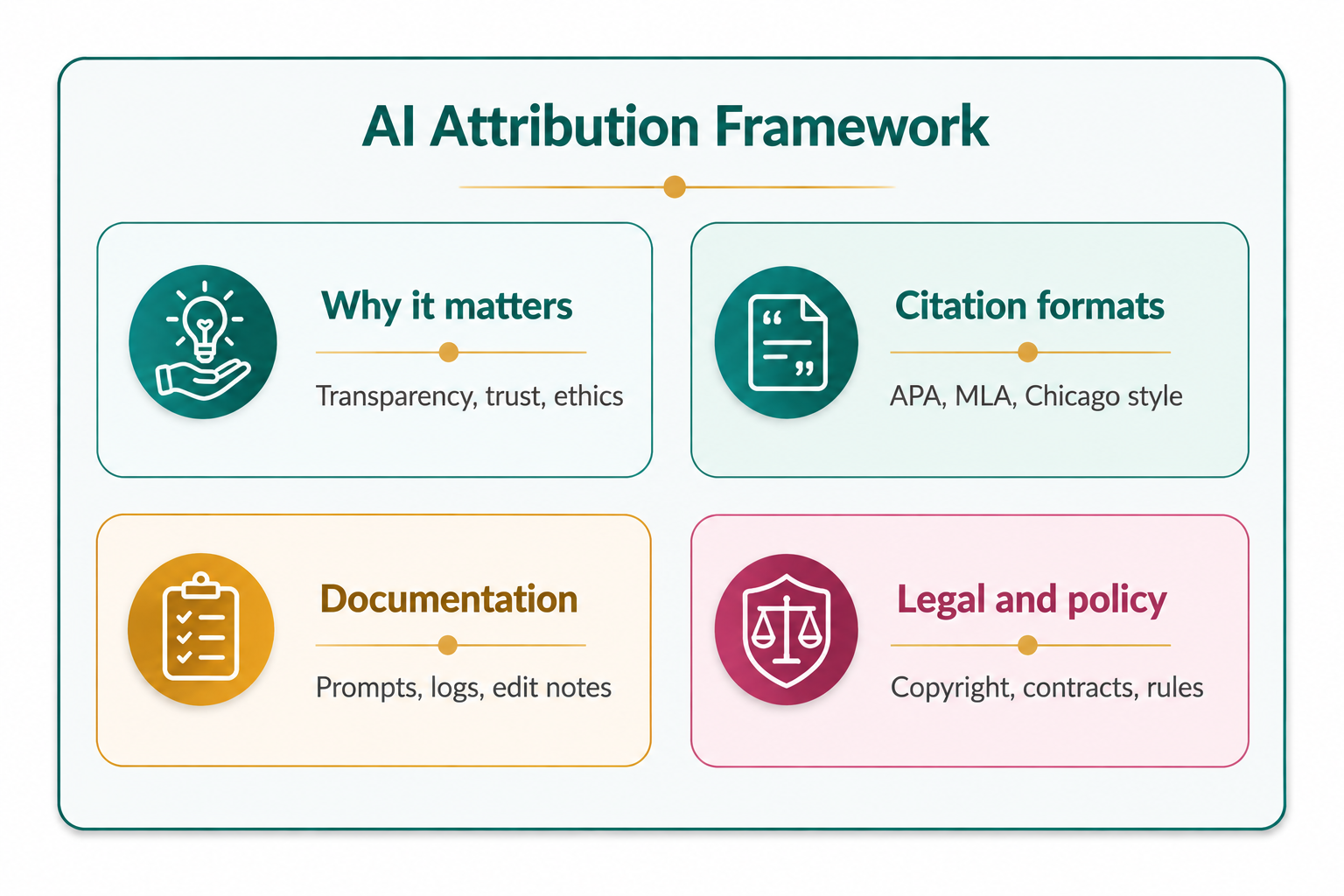
Why Citing AI Assistance Matters?
Attribution is not only important in name; it determines the credibility or originality of your work among readers, institutions, and partners. Understanding the importance of attribution will make following the guide simpler.- Transparency: This allows you to build trust with your audience, your employer, or an educational institution because you make your process transparent and not opaque.
- Accountability: This always lies with the author, even if some tools contributed to the content; therefore, proper attribution can protect you in case any mistakes or biases become apparent later.
- Academic Integrity: This treats AI without disclosure just like collaboration or ghostwriting without disclosure.
- Intellectual Honesty: This helps to make sure credit is given to both humans' original ideas and to the contributions of the AI tool.
- Reputation Protection: This will prevent future allegations of plagiarism or fraud that can affect you far beyond a single paper.
Institutional Rules
Various institutions have different rules regarding expectations for disclosing the use of AI. Having information on where you stand can help prevent you from breaking the rules unknowingly.- Universities: This mandates students to mention any use of AI in a disclaimer, footnote, or appendix, with details differing between different departments and subjects.
- Academic Publications: Academic papers like Elsevier, Springer Nature, and JAMA ban AI authors but mandate mentioning their use in methodology or acknowledgements sections.
- News & Media: Associated Press and Reuters have issued internal guidelines for mentioning AI usage in articles where it plays an important role in framing the narrative or doing research.
- Organizations: Companies are now developing their own internal AI usage policies detailing what has to be mentioned about AI use in client deliverables, particularly in legal, medical, and financial writings.
- Conferences: Conferences often ask for a separate AI disclosure section besides the usual acknowledgement section.
Citation Formats
Once it becomes clear that disclosure is necessary, the next step is how to format it. All major style guides have slightly different approaches toward citing AI sources. A few examples have been discussed below:- APA Style: This recommends that the text should be attributed to the AI tool itself as the author and the company as the publisher, with the date and the URL provided.
- MLA Style: This recommends that the output of the AI tool is considered "unauthored" or a "container" and needs to be cited by mentioning the name of the tool, the prompt given, the company, and the date of access.
- The Chicago Style: This suggests that you can choose between a footnote and a bibliographical style citation according to the preference of the discipline.
- In-text Citations: These are added when writing a small paper and mentioning that the text was "drafted with AI assistance."
- Prompt Inclusions: These become more important and should be included in an appendix if the discipline requires.
Documenting Process
A citation alone is just a part of the process. Maintaining an ongoing list of your use of AI serves as a safeguard in case your process is ever put into question. The process used is discussed below:- Version Tracking: This enables you to differentiate between your original drafts and the AI-revised portions, particularly when there are issues related to authorship.
- Prompt Logs: This provides an accurate account of the actual instruction provided, which increases transparency and makes reproduction of your findings possible.
- Edit the summary: Changes you have made following the AI output, demonstrating the human intervention that occurred in addition to AI generation.
- Tool Specification: The specific version of the tool (and not simply "AI"), is necessary since the capabilities and outputs of the various versions differ.
- Timestamps Records: Records of interactions with AI systems can be used as evidence of your intent to disclose when needed by any reviewing institution.
Common Errors During Citations
However well-intentioned the authors may be, errors are made in acknowledging the use of AI. This is what commonly causes the problems in the first place. A few common mistakes are discussed below:- Vague Disclosures: Disclosures such as "the use of AI" and fail to give details as to where and how do not help the readers make a decision on the extent of human versus computer involvement in the research.
- Overcrediting: Listing the AI tool as a co-author is erroneous in that most guidelines do not allow AI to be an author.
- Underdisclosure: Omitting the use of AI altogether in editing, even the slightest bit, in a research paper, makes it seem as though the information is being concealed.
- Use of Inconsistent Formats: In one document, some sections that were done using AI have been referenced, but not all of them, which brings down the entire disclosure.
- Ignoring Policy Updates: This becomes risky because guidelines regarding AI are rapidly evolving, and what was once considered appropriate is no longer acceptable.
Legal Considerations
There are some practical aspects related to the use of artificial intelligence in addition to ethics and style, which many authors ignore, such as:- Copyright Issues: Copyright issues related to AI-generated content are ambiguous in many regions, with many organizations rejecting the notion of copyright of machine-produced texts.
- The Terms of Service: These rules of each AI product determine the ownership and permissions to use the output materials, so examining them before publishing for business is vital.
- Client Contracts: Contracts that exist in freelance or agency work specify that AI-generated content needs to be disclosed, thus making the act of attribution mandatory, rather than optional.
- Data Privacy: Data breaches are a major issue in the case of data inputting into AI software is the matter, as some sensitive information can lead to legal restrictions on publishing.
- Liability Exposure: This lies with the person who publishes something; undisclosed errors, citations, or plagiarism can still have consequences for the user, even though done through AI.
Field Variations
There is no one universal standard for the disclosure of AI technology. It changes greatly from field to field that you write in. Given below are some common fields with varied citation styles:- Academic Writing: This requires full disclosure, sometimes requiring a method statement on its own, in addition to the professor’s or committee's permission before submission.
- Journalism stresses: The aspect of disclosure that is connected to the readers' trust, usually requiring an editor’s note if the AI impacts the research, drafting, or the creation of images.
- Creative Writing: These genres have divergent views, with some publishers prohibiting the submission of works generated with the help of AI and others merely asking for disclosure while submitting.
- Business and Marketing: This content may require a light disclosure policy, but the regulated spheres of finance, law, and health care require much stricter policies.
- Technical and Programming: The writing sometimes expects attribution in the commit message or in the comment in the code.
Sample Disclosures
Practical examples make it easier to apply disclosure. This is an example of a practical, honest disclosure statement that can be applied in a number of forms.- The Short Form: This works for a blog post or article like "I used an AI tool to help me draft sections of this work, then went through it all myself before publishing."
- An Academic Disclaimer: This should be placed in the methods or acknowledgments section: "I used [name of tool and version] to help me with [specific function such as literature summarization or language editing]. The results, conclusions, and interpretations expressed in this paper are mine alone."
- The Journalistic Disclaimer: This is often an editor's note: "AI tools were used in researching this story. All facts in the story have been independently verified by our editorial staff."
- The Portfolio Disclaimer: This is a one-time statement that can be posted on your website: "A couple of the pieces in my portfolio were assisted in some way by AI tools, either with the idea generation or editing process. I've noted the specific information on each project page."
- The Full Detailed Appendix: This entry should name the tool and version you used, the date of use, a general description of what the tool was asked to do, and your own changes made to the generated text before inclusion in the report.
Conclusion
AI attribution is becoming a standard across academia, journalism, and professional writing. The key is to be clear, precise, and transparent about how AI was used. Proper attribution protects your credibility, respects your audience, and keeps you prepared as AI standards continue to evolve.
Frequently Asked Questions
1. Do I need to cite AI assistance even if I only used it to check grammar?
Most current guidelines distinguish between light editing assistance (like grammar or spell-checking) and substantive content generation. Light editing typically doesn't require formal citation, but check your specific institution's or publisher's policy, since some now require disclosure regardless of scope.
2. Can I list an AI tool as a co-author on a paper?
No major style guide, journal, or academic institution currently recognizes AI as a legitimate author. AI tools cannot take accountability for accuracy or hold intellectual responsibility, so they should be cited as a tool used, not credited as a contributing author.
3. What's the difference between citing AI and citing a source it references?
Citing AI credits the tool for generating or assisting with content you produced. Citing a source means crediting original material the AI may have referenced or summarized and one should independently verify and cite that original source separately, since AI-generated citations aren't always accurate.
4. How do I cite AI assistance in a job or creative portfolio, where there's no formal style guide?
A short, plain-language disclosure statement works well, for example, noting which pieces involved AI brainstorming, drafting, or editing assistance, and roughly how much of the final work reflects your own revision versus the tool's output.
5. Will AI citation standards keep changing?
Yes. Because generative AI capabilities and institutional trust in them are evolving rapidly, expect style guides, universities, and publishers to keep updating their requirements. Revisiting your citation approach every few months, rather than treating it as fixed, is a good practice going forward.

0 Comments