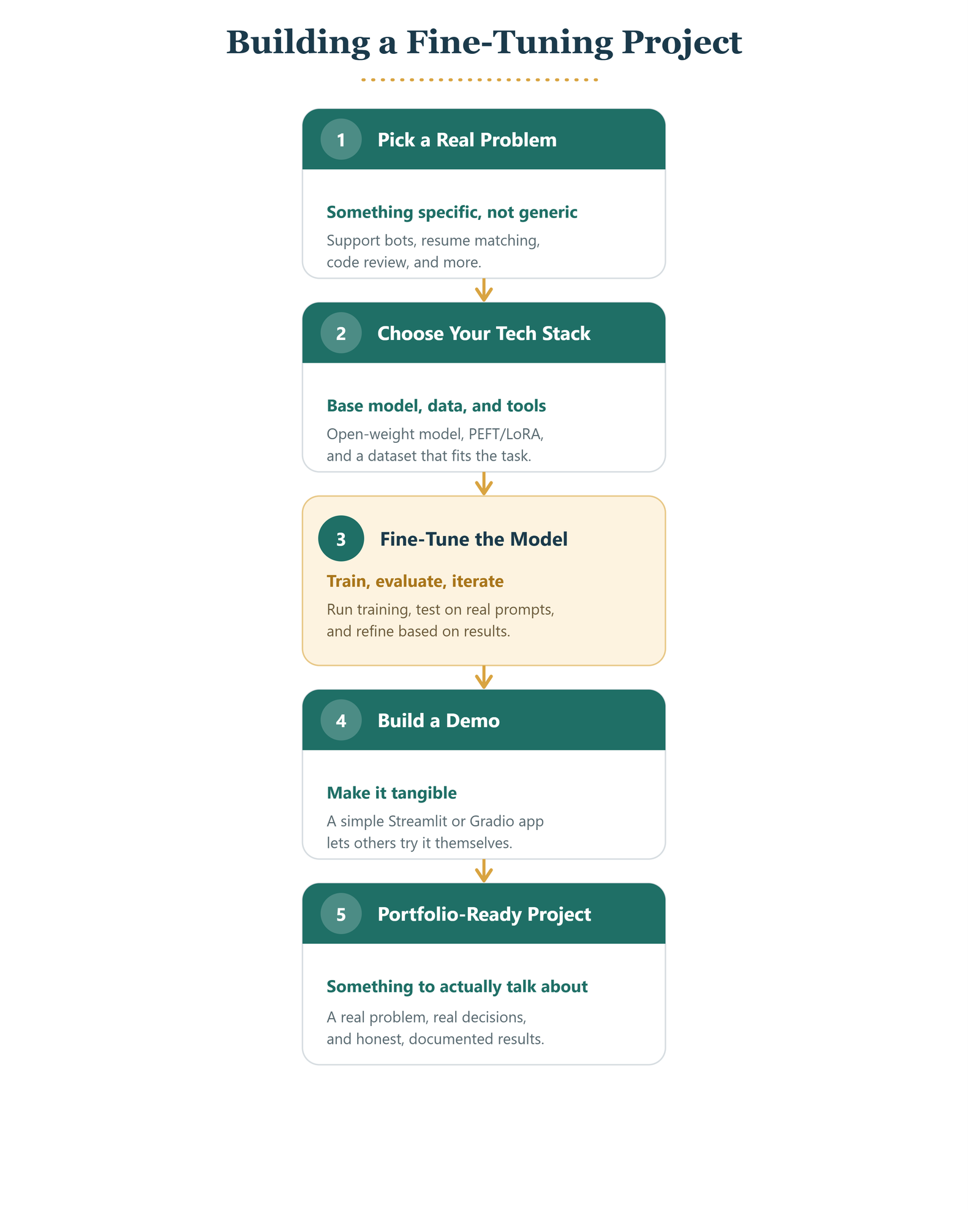
The theory behind fine-tuning is one thing, but nothing drives the idea home quite like doing a project yourself. When you’re a student trying to land an AI/ML job, having a portfolio filled with copies of existing tutorials won’t leave nearly as big an impression as having done a project to solve a particular, realistic problem by fine-tuning a model. Fortunately for us, there’s no need for a massive budget or a research lab to have some really solid results – parameter-efficient approaches such as LoRA mean that even a serious fine-tuning project is possible to complete with just a single consumer-grade GPU or even free cloud notebooks. This article will take a look at a few interesting project ideas to build, each of which comes with its own well-defined problem statement, realistic technical stack, and key functionality needed.
Table of Contents
Why Build Fine-Tuning Projects as a Student?
But simply understanding how to fine-tune a language model isn't enough; getting your hands on real-world work of an AI project that tutorials usually gloss over (data preparation, evaluation, compromise when computing resources are scarce) is exactly what sets someone who has experience with machine learning apart from someone who simply knows about it. The documentation of a properly prepared fine-tuning project will also give you a concrete way to demonstrate those skills in interviews.
- Demonstrates Practical Skill: Building develops practical skills and not just theory, and recruiters and interviewers can see the difference between knowing fine-tuning and having really done fine-tuning.
- Portfolio Project: Builds a truly unique portfolio project because a solution to a particular problem is far more impressive than yet another chatbot copy.
- Data Skills: teaches data skills, in addition to model skills. Preparing and cleaning a dataset is sometimes more challenging and educational than training the model itself.
- Evaluation: It Makes You think about evaluation, where figuring out how to measure your success is a valuable skill that tutorials don't always teach.
- Realistic Constraints: It does so within realistic constraints, as fine-tuning with realistic compute is much closer to reality than tutorial-style infinite compute.
Requirements Before Starting A Project
In preparation for getting into a particular project, having a number of these building blocks is quite useful to prevent yourself from struggling with setup problems mid-way. Most of these components are usually freely available, which also adds to why it makes fine-tuning projects realistic at the student level. Setting up these components beforehand will help you save much time later.- Base model for Fine-Tuning: Open-source models such as Mistral, Llama, or their smaller versions can be found quite easily.
- Training Environment Access: Free-tier solutions such as Google Colab and Kaggle notebooks should be sufficient for fine-tuning based on LoRA.
- Fine-Tuning Library: Libraries like Hugging Face's Transformers and PEFT take care of most of the underlying details for you.
- A Scoped Dataset: Public datasets or a smaller, manually assembled dataset pertaining to the problem you choose to solve.
- Simplistic Means for Demonstrating Results: A very basic demo application that can use Streamlit or Gradio.
Project Ideas at a Glance
Seeing all five projects side by side makes it easier to pick one that matches your interests, available time, and comfort level with different tools. The table below summarizes each option.
| Project | Domain | Difficulty Level | Suggested Base Model |
|---|---|---|---|
| Niche Customer Support Chatbot | Customer service/e-commerce | Beginner to intermediate | Mistral 7B or Llama 3 8B |
| Resume-to-Job Matching Assistant | HR tech/recruiting | Beginner | DistilBERT or a small LLM |
| Regional Language Assistant | NLP / accessibility | Intermediate | Multilingual mT5 variant |
| Code Review Assistant | Developer tools | Intermediate to advanced | CodeLlama or StarCoder |
| Legal Contract Summarizer | Legal tech | Intermediate | Open-weight LLM with LangChain |
Unique Project Ideas Covering The Depths of Fine- Tuning
Each of the projects below is scoped to be realistically buildable within a few weeks, while still tackling a real, specific problem rather than a generic demo. They span different domains on purpose, so you can pick whichever one aligns best with your interests or target career path. These project ideas include the objective, tech stack, and functionality needed in the project.
Project 1: Niche Customer Support Chatbot
Problem Statement: This project overcomes the lack of efficiency and accountability in the e-commerce sector involving customer service features.
- High Cost: Chatbots tailored for certain business domains are simply too costly for small businesses.
- Adherance of Company Policies: Standard AI-powered assistants lack comprehension of specialty products, company policies, and return policy.
- Poor Customer Service: Clients will receive inappropriate responses to their queries, which results in poor customer service.
Tech Stack:
- Base model: Mistral 7B or Llama 3 8B
- Fine-Tuning Method: LoRA via the Hugging Face PEFT library
- Dataset: Synthetic or scraped support tickets and FAQ pairs
- Backend: FastAPI or MCP
- Interface: Streamlit or Gradio for the demo
Functionality:
- Accuracy: Answers product-specific and policy-specific questions accurately.
- Maintenance: Maintains context across a multi-turn conversation.
- Efficiency: Escalates to a placeholder "human agent" flow when confidence is low.
Project 2: Resume-to-Job-Description Matching Assistant
Problem Statement:
- Large Numbers of Applicants: Recruiters struggle to quickly judge resume-to-job fit at scale.
- Lack of Context: Keyword-only matching misses context and nuance in candidate experience.
- Scalability: Manually reviewing every application isn't practical for high-volume hiring.
Tech Stack:
- Base Model: DistilBERT or a lightweight LLM
- Fine-Tuning Approach: Classification fine-tuning or prompt-based scoring
- Dataset: Public resume and job description pairs
- Supporting Logic: Scikit-learn for auxiliary scoring
- Interface: Flask or Streamlit
Functionality:
- Accuracy: Scores how well a resume matches a given job description.
- Efficiency: Highlights specific matching and missing skills.
- Improvements: Suggests resume phrasing improvements based on the job description's language.
Project 3: Regional Language Assistant
Problem Statement:
- Performance Issues: Most large language models perform poorly in regional or low-resource languages.
- Poor Accessibility: Non-English-speaking communities often lack access to genuinely helpful conversational AI.
- Struggles to Reach a Larger Audience: Direct translation-based tools tend to sound stiff and culturally disconnected.
Tech Stack:
- Base model: A multilingual mT5 variant or multilingual-capable open LLM
- Fine-Tuning Method: LoRA
- Dataset: Open regional-language corpora, such as AI4Bharat or OSCAR
- Deployment: Hugging Face Spaces
Functionality:
- Efficiency: Handles everyday conversational queries in the target regional language.
- Management: Manages code-switching between the regional language and English.
- Human-like Language: Produces culturally appropriate, natural-sounding responses rather than stiff translations.
Project 4: Code Review Assistant for an Open-Source Project
Problem Statement:
- Different Coding Style: Generic AI coding assistants don't understand a specific project's coding conventions.
- Clashes wth Source Code: Suggested code often conflicts with existing patterns already in use.
- Time-Consuming: Maintainers spend extra time correcting AI-generated suggestions during review.
Tech Stack:
- Base Model: CodeLlama or StarCoder
- Fine-Tuning Method: LoRA
- Dataset: Commit history and pull requests pulled via the GitHub API
- Packaging: CLI tool or lightweight editor extension
Functionality:
- Maintains Pattern: Flags code that diverges from the project's established style and conventions.
- Efficient Resolution: Suggests specific fixes aligned with existing patterns in the codebase.
- Easy Solutions: Generates concise, plain-language summaries of proposed pull requests.
Project 5: Legal Contract Summarizer
Problem Statement:
- Time Consumption: Reading lengthy contracts to identify key clauses is time-consuming.
- Legal Understanding: Understanding legal language often requires expertise that many people don't have.
- Understanding Documents: Risky or unusual clauses can go unnoticed without a legal background.
Tech Stack:
- Base Model: An open-weight LLM fine-tuned on legal text
- Dataset: Public legal dataset, such as CUAD
- Document Handling: LangChain for chunking long contracts
- Interface: Streamlit for uploading and reviewing documents
Functionality:
- Summary: Extracts and summarizes key clauses from an uploaded contract.
- Provides Caution/Warning: Flags clauses that may carry unusual risk or deviate from standard terms.
- Decoding Complex Documents: Explains complex legal language in plain, accessible terms.
Common Challenges Students Face When Building Fine-Tuning Projects
Common problems that well-specified student projects will usually encounter are no different, and knowing about them ahead of time may save several days of frustrated debugging. The vast majority of issues have more to do with data quality and reasonable expectations rather than the actual algorithm used for fine-tuning.
- Extra Time: Not accounting for extra time spent on cleaning, as original datasets are rarely ready for training and require much more preprocessing time than anticipated.
- Selecting a Too-Large Base Model: Selecting a model that is too big for existing computational resources causes frustrating memory-related issues and hinders iterative development.
- Improper Evaluation: Not having an evaluation strategy from the very beginning leads to not defining success criteria upfront, which prevents evaluating whether fine-tuning has helped or not.
- Overfitting on a Tiny Dataset: Datasets that are too small and specific prevent the model from learning general rules rather than memorizing examples.
- Not Thinking of a Demo Layer for the Project: A technically sound model without a demo component will be difficult to demonstrate effectively.
Tips for Presenting Your Project
Even a good fine-tuning project from the technical standpoint might fail during an interview or portfolio presentation if poorly conveyed. The way you convey your thinking can be equally important as the results obtained because it will give a lot of information about your real understanding of the process. Sometimes, a few extra minutes spent on this aspect can make all the difference.
- Detailed Explanation: Explain your data selection, not just the results. Be prepared to answer the question of why this particular data set was used and what you did with it.
- Clear demonstration: Comparison of outputs of the initial model and your model shows the advantage in an intuitive way.
- Description of Evaluation: This is the proof of your understanding of the problem better than "it seemed to work".
- Honest Limitations: Admission of the shortcomings of your model is a sign of realistic understanding.
- Availability of Demo: A live demo is always better than a description.
Conclusion
A fine-tuning project in practice could well be considered the best way to make a student transition from learning about AI techniques on a theoretical level to acquiring some hands-on experience. If it’s a custom support bot, a resume matching system, or a code review assistant for some open source project, the key point here would be addressing an actual problem and not simply following some textbook example. In the course of completing the project, the student would gain some practical skills such as data curation, evaluation, and proper management of resources, which are just as important as the fine-tuning technique itself.
Frequently Asked Questions
1. Do I need a powerful GPU to complete these projects?
Not necessarily. Parameter-efficient methods like LoRA make it possible to fine-tune smaller models on free-tier platforms like Google Colab or Kaggle notebooks.
2. How large should my training dataset be for a student project?
There's no strict minimum, but a few hundred to a few thousand clean, relevant examples are often enough to see a noticeable improvement over the base model.
3. Which project is best for a beginner with limited fine-tuning experience?
The customer support chatbot or resume-matching assistant tends to be a more approachable starting point, since they involve simpler data structures and clearer success criteria.
4. Should I build the project from public datasets or collect my own data?
Either works well, though a mix is often ideal. Public datasets provide a solid foundation, while a small amount of custom data can make the project feel more original.
5. How do I know if my fine-tuned model actually improved over the base model?
Compare outputs directly on the same set of test prompts, and where possible, use a simple evaluation metric or structured human review to confirm the improvement is real, not just anecdotal.

0 Comments