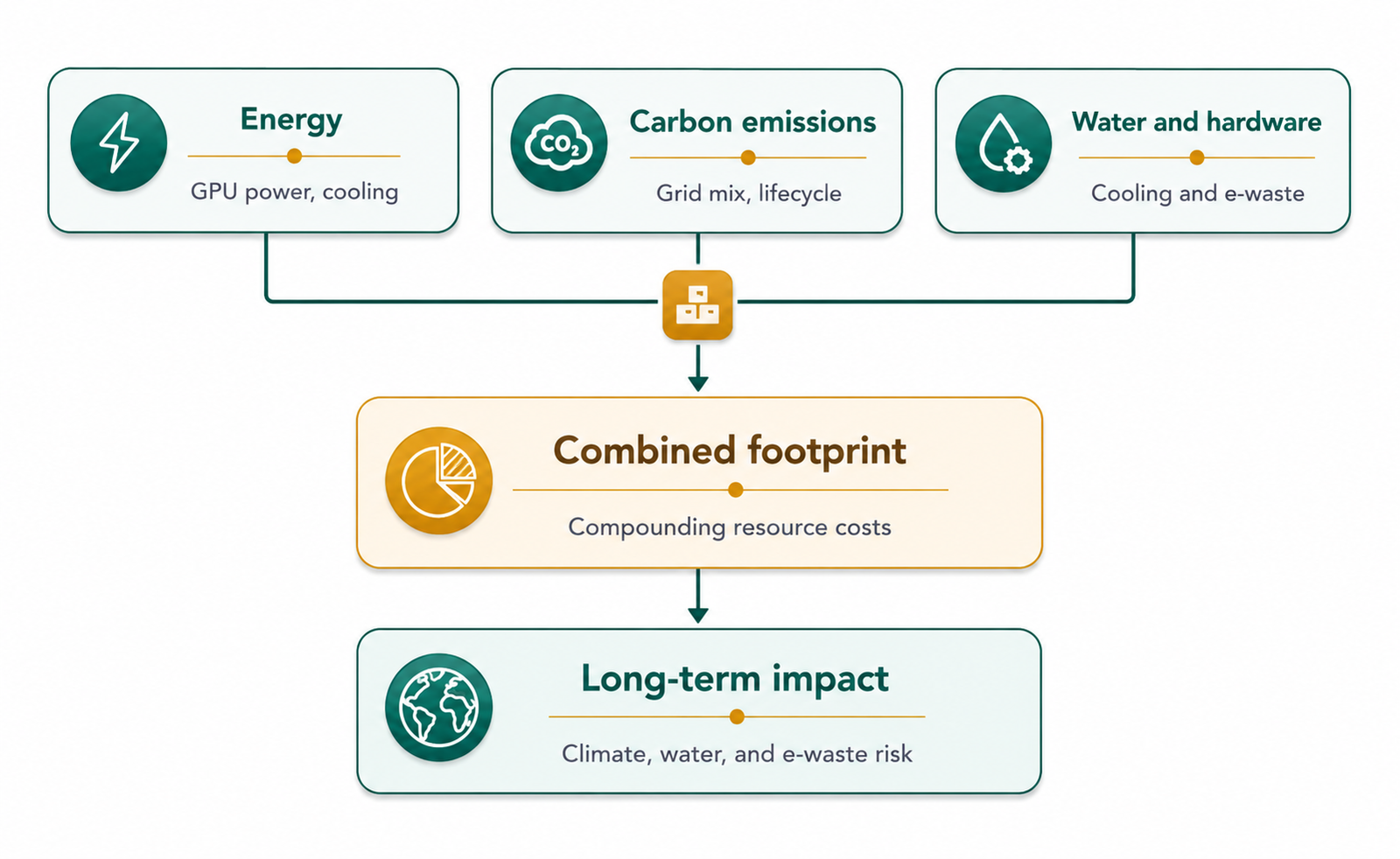
Whenever a new big language model comes out, its benchmark metrics and capabilities are frequently compared, but little consideration goes into the environmental costs of the product. Big AI model training is known for being very resource-intensive; it uses huge amounts of energy and water, produces lots of carbon emissions, and adds to e-waste. With the ongoing growth in the field, such hidden costs have become a critical sustainability problem. In this article, we will discuss the nature of big AI models, the importance of their environmental effects, resource consumption, sources of environmental damage, and mitigation measures.
Table of Contents
What Large AI Models Actually Are?
Before we look at the environmental impact, it is useful to understand what a "large AI model" means and why the model's scale is the core of the problem.
- Billions of Parameters: Large models are neural networks characterized by having billions or trillions of internal parameters that are iteratively updated to achieve better results.
- Trillions of Inputs: To train such large models requires processing massive amounts of data, sometimes trillions of words or images that may happen several times during one training session.
- Dependence on Specialized Hardware: Training such large models, unlike typical software programs, requires specific hardware like GPUs or TPUs capable of matrix computations.
- Trial and Error Process: Usually, getting the final product involves several attempts of training and iterations rather than only one session.
- Size As A Strategy: The strategy of increasing the size of models in order to achieve better performance became the most popular one in recent years and directly increases all costs mentioned in this article.
Why This Topic Matters Now?
AI training’s impact on the environment is not merely a technical issue that has no relevance outside of the technology realm; it ties together climate politics, use of public resources, and even the rate at which the industry moves forward.
- Exponential Growth Curve: Models' sizes and computing requirements for their training have exploded in just a few years, meaning that current environmental costs represent a floor rather than a ceiling.
- Public Resources Competition: The competition for local electricity and water between data centers and other sectors, like households or agriculture, is only getting steeper.
- Commitments to Climate Action at Risk: Growing AI-related energy demand may become an obstacle to meeting climate commitments if not coupled with equally large investments in renewables.
- Legal Scrutiny: Policymakers and the judiciary start to pay closer attention to emissions, water withdrawals, and data center permits, giving legal backing to what used to be a purely voluntary discourse.
- Reputation Risks: Public awareness of environmental issues leads to consideration of how a company manages its environmental impact as part of its overall reputation.
How Training Run Consumes Resources?
The knowledge of how exactly training works from the preparation stage to shutdown would help you better understand the statistics provided later in the paper.
- Data Pre-processing Phase: Even at the pre-training phase of preparing the data for use in training models, cleaning and filtering huge amounts of data takes time and energy.
- Continuous Parallel Processing: At the training phase, thousands of processors act in perfect synchronization with constant data exchange, so the consumption of energy becomes constant.
- Energy Consumption Through Heat: All energy used in computations turns into heat eventually, and all this heat should be removed constantly using air or liquid cooling.
- Checkpointing and Repeated Runs: The processes of saving and repeating training sessions after failures or modifications mean that actual energy expenses are higher than expected.
- Post-Training Testing Phase: At the post-training phase, after all the training is finished, additional testing and benchmarking runs require computing resources and energy.
The Energy Appetite Of Modern AI
Training frontier models is a process involving energy consumption on an industrial scale, not only software. The magnitude of this energy hunger is the first step in telling the whole environmental story.
- Thousands of GPUs: Training sessions for frontier models frequently use clusters containing tens of thousands of GPUs or other accelerators operating nonstop for weeks or months.
- Megawatt Clusters: A large-scale modern training cluster can consume more than 100 megawatts of power continuously, the same amount as consumed by a medium-sized city.
- Diminishing Efficiency Gains: As computer chips continue to improve in efficiency per operation performed, the growth in size of models and the data sets feeding them has been outpacing that improvement.
- Cooling Needs: A substantial portion of the total electricity consumption in a data center does not go toward performing the computations but is used to cool the equipment performing them.
- Utility-Level Impact: In locations where there are clusters of data centers, AI training is already beginning to appear in utility forecast and planning documents.
Carbon Emissions Across The Model Lifecycle
The importance of electricity consumption in environmental terms only comes in due to the source of this electricity. Emissions associated with the operation of AI training depend as much on geography and the grid makeup as on the actual computational power.
- High-Fossil Fuel Grids: If the training session takes place in a region whose grid is still based heavily on coal or gas, the emissions may end up being significantly higher than for the same training session on a renewable-dominated grid.
- Renewable Energy Certificates: Companies may purchase renewable energy certificates to account for the emissions associated with their training sessions, although the electricity powering the servers could well come from non-renewable sources.
- Localized Emission Spikes: In contrast to dispersed consumption of electricity over time, training emissions tend to take place in short but intensive bursts, causing local spikes in both demand and emissions.
- Post-Training Considerations: Once the model has been deployed, emissions associated with inference can eventually add up to surpass those related to the training process itself.
- "Embodied" Emissions: The production of the chips, servers, and data center infrastructure produces its own carbon footprint, which tends to be overlooked when discussing emissions.
Water Consumption Behind The Scenes
Water is the least obvious cost of training AIs, but sometimes it becomes the most disruptive cost, especially when it comes to drought-prone areas, where the data centers start clustering.
- Evaporative cooling: Most data centers make use of evaporative cooling towers. The latter utilizes huge amounts of freshwater to cool down servers.
- Direct Use on the Site: A single big training session can take hundreds of thousands of gallons of water from data centers.
- Indirect Use of Water at the Power Plants: Production of electricity in order to run a data center takes water at power plants. That is why the amount of water that will be used indirectly is even bigger than the one used directly.
- Inequalities of Geographical Distribution: In arid areas, facilities may become a burden on local water sources because of their location.
- Large Efficiency Gaps: There are facilities with air cooling in the desert that use much less water than evaporative cooling in other places.
Hardware, E-Waste, And The Supply Chain
The environmental problem doesn’t stop when the training ends; rather, it starts way back during chip fabrication and extends well beyond model retirement through the disposal of hardware.
- Resource-Intensive Chip Fabrication: The creation of high-performing AI accelerators requires rare minerals, highly purified water, and energy-intensive manufacturing techniques within cleanrooms.
- Short Hardware Lifecycles: Frequent updates to AI hardware accelerate waste generation since GPUs and accelerators get disposed of way before they become obsolete.
- Increasing E-Waste Generation: The disposal of servers, cooling components, and accelerators results in an increasing amount of specialized e-waste.
- Dependence on Critical Minerals: The process of fabricating chips is dependent on minerals whose extraction has its own negative environmental and social impacts.
- Inadequate Frameworks: Recycling systems for AI-specific hardware are still underdeveloped compared to the amount of hardware used and disposed of.
Industry Responses And Mitigation Strategies
In the face of increasing scrutiny, AI companies and researchers are employing various tactics to mitigate the environmental impact of training processes, although with varying degrees of success.
- Sparse and Efficient Architectures: Sparse mixture-of-experts architectures involve only the activation of a portion of the total number of parameters on each task, reducing computational demands drastically when compared with fully dense architectures.
- Renewable-Powered Data Centers: Companies are setting up their training data centers close to renewable sources of power or investing in wind/solar farms that would supply such data centers.
- Improved Cooling Mechanisms: Facilities are moving away from evaporative cooling systems to liquid immersion cooling solutions, which use far less water than the former.
- Carbon-Aware Scheduling: In some cases, training operations can be scheduled for times and locations when the grid electricity available is cleanest.
- Increased Transparency: Increased scrutiny on the part of researchers, regulators, and the public is driving more companies to release statistics related to energy, water, and carbon use during training sessions.
Conclusion
The environmental cost of AI model training is an intrinsic issue, rather than a small one. With AI scaling, there comes an increase in energy consumption, carbon emissions, water usage, and e-waste production. Although there is no magic formula to solve all these problems at once, there are approaches that allow for the reduction of all these factors considerably. Sustainable development is important both for the future of AI itself and for the environment.
Frequently Asked Questions
1. How much electricity does it take to train a large AI model?
Training a frontier-scale model can require well over a thousand megawatt-hours of electricity, drawn from clusters of thousands of GPUs running continuously for weeks, though the exact figure varies widely by model size and hardware efficiency.
2. Does training or everyday use of AI cause more emissions overall?
Training produces a large one-time emissions spike, but for widely used models, the cumulative emissions from ongoing inference, millions of daily queries, can eventually surpass the original training footprint within weeks or months.
3. Why does AI training use so much water if it's a digital process?
Water is used to cool the physical servers and chips performing the computation, either directly through evaporative cooling towers or indirectly through the power plants generating the electricity that runs the data center.
4. Can renewable energy fully solve AI's environmental impact?
Renewable energy significantly reduces carbon emissions from training, but it does not eliminate water use, hardware manufacturing impacts, or electronic waste, all of which require separate mitigation strategies.
5. What can AI companies do to reduce this footprint without slowing progress?
Companies can adopt more efficient sparse model architectures, site data centers near clean power and favorable cooling climates, invest in advanced cooling technology, and publicly report energy and water metrics to build accountability.

0 Comments