Basically, Java converts human-readable source code into an intermediate representation (bytecode) that is executed by a standardized runtime, the Java Virtual Machine (JVM), which converts it into machine code (0/1).
Table of Contents
Features of Java
Java provides a wide range of powerful features that make it one of the most popular programming languages. These features help developers build secure, reliable, and platform-independent applications. Below are the key features of Java.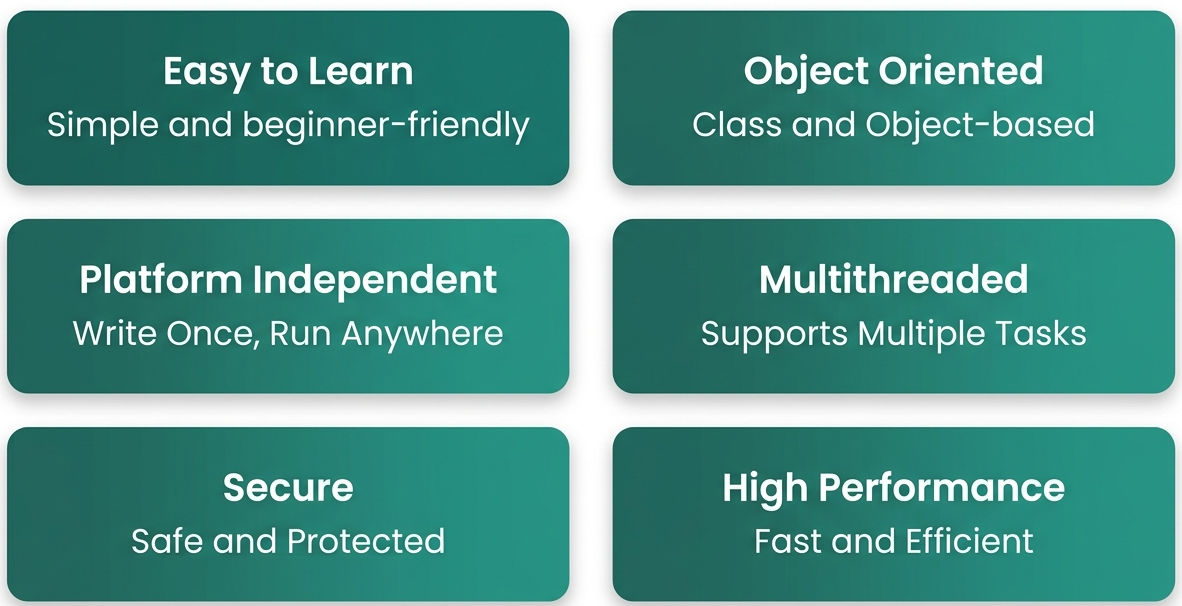
- Easy to Learn: Java is a simple programming language that is easy to learn and use. Its syntax is similar to C and C++, which makes it familiar for beginners. At the same time, it removes complex features like pointers, making programs easier to write, understand, and maintain.
- Object Oriented: Java is an object-oriented programming language based on concepts like classes and objects, inheritance, polymorphism, and encapsulation. These principles help in organizing code in a structured way, making it reusable, modular, and easier to maintain.
- Platform Independent: Java is a platform-independent programming language, meaning its code can run on any system that has a Java Virtual Machine (JVM). This is possible because Java programs are converted into bytecode, allowing the same code to work on different platforms—hence the principle “Write Once, Run Anywhere.”
- Multithreaded: Java is a multithreaded programming language, which means it can perform multiple tasks simultaneously. This allows better utilization of system resources and improves performance, making it especially useful for applications like games, mobile apps, and servers.
- Secure: Java is a secure programming language that prevents unauthorized access and ensures safe execution of programs. It does not allow direct memory access and uses bytecode verification along with built-in security features to protect systems from potential threats.
- High Performance: Java provides high performance through the use of a Just-In-Time (JIT) compiler, which converts bytecode into native machine code at runtime. This makes Java faster than traditional interpreted languages.
Applications of Java
Java is widely used in various fields due to its flexibility and reliability. It supports the development of multiple types of applications, making it a popular choice among developers. Here are some popular applications of Java: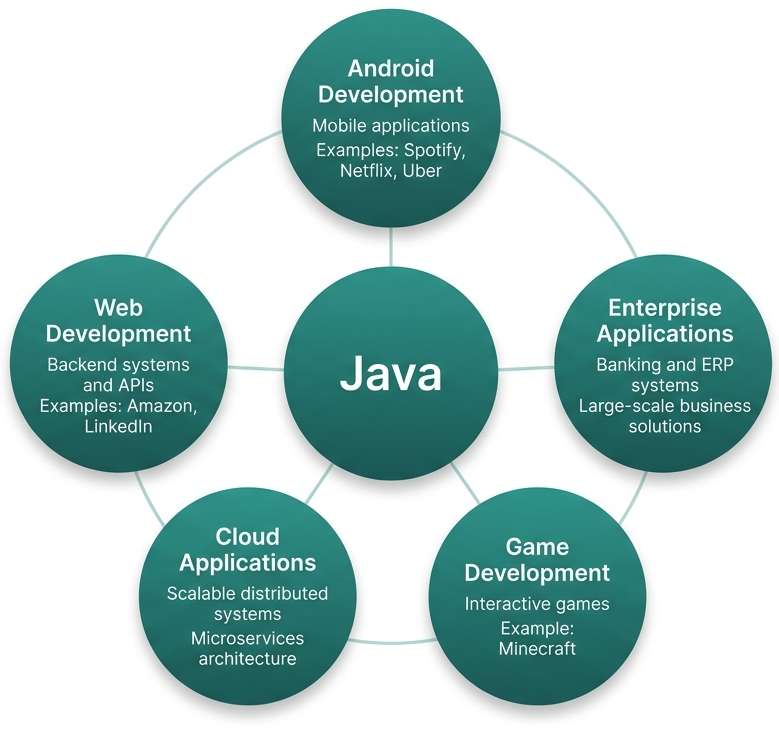
Some of the popular apps built using Java:
- Spotify: Music streaming app
- Netflix: Video streaming platform
- Uber: Ride-booking application
Some of the popular web apps built using Java:
- Amazon: It uses Java for backend services and handles millions of users and transactions.
- LinkedIn: It uses Java for scalability and performance and handles a large number of user data.
Some of the examples of enterprise applications using Java:
- Banking Systems: Java is used in many banking applications because of its reliability and security features.
- Hospital Management Systems: Java is also used in making management system applications.
5. Cloud Applications: Java is widely used in cloud applications for building scalable and distributed systems. It supports the development of cloud-based services and microservices, making it suitable for modern, flexible application architectures.
Conclusion
Finally, we can conclude that Java is a powerful, versatile, and widely used programming language known for its simplicity, security, and platform independence. Its object-oriented nature and robust features make it suitable for developing reliable and scalable applications. Java supports multithreading, high performance, and strong memory management, which enhances its efficiency. It is used in various domains such as Android development, web applications, enterprise systems, cloud computing, and game development. These wide-ranging applications highlight Java’s importance in modern software development. Overall, Java continues to be a preferred choice for building secure, efficient, and cross-platform applications.Frequently Asked Questions
1. What is Java?2. Why is Java platform independent?Java is a high-level, object-oriented programming language used to develop various types of applications such as web, mobile, and enterprise systems.
3. What are the main features of Java?Java is platform independent because it converts code into bytecode, which runs on the Java Virtual Machine (JVM) on any system.
4. Where is Java used?Some key features of Java include simplicity, object-oriented nature, security, robustness, multithreading, and platform independence.
5. What is JVM in Java?Java is used in Android app development, web development, enterprise applications, cloud computing, and game development.
JVM (Java Virtual Machine) is a runtime environment that executes Java bytecode and converts it into machine code for execution.

0 Comments