If you’ve ever opened a coding platform or an aptitude book and felt lost about where to begin, you’re not alone. The real problem isn’t lack of effort. It’s lack of direction.
This guide is built to fix that. Instead of vague advice, you’ll see clear topics, repeated question patterns, and practical preparation steps that match what actually happens in placements.
Table of Contents
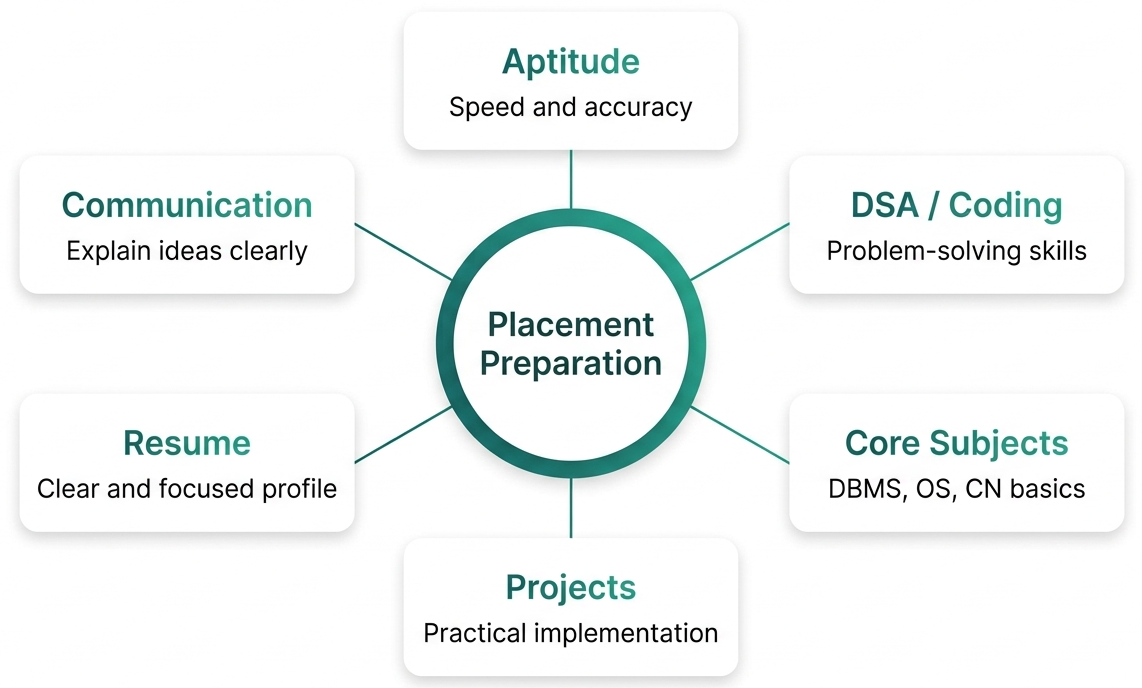
What Placement Preparation Actually Means?
Placement preparation is the process of getting ready for predictable hiring rounds, not random exams.
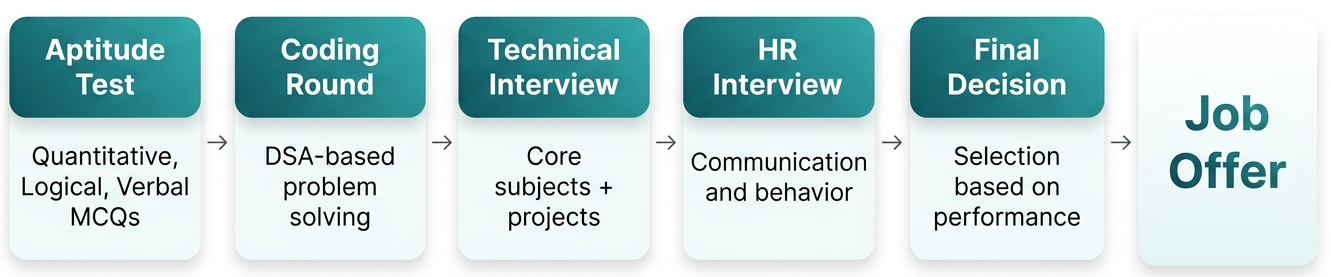
Almost every company follows a similar structure:
| Stage | What Actually Happens | What You Need to Focus On |
|---|---|---|
| Aptitude Test | Timed MCQs with elimination rounds | Speed + basic formulas |
| Coding Round | 1-3 DSA-based problems | Logic + pattern recognition |
| Technical Interview | Questions from subjects + projects | Clear concepts |
| HR Interview | Behavioral + personality questions | Structured answers |
What this really means is you don’t need to study everything. You need to prepare for these four filters.
The Shift Most Students Miss
A common mistake is preparing topic-wise without understanding how questions are framed in interviews.For example, students say:
But interviewers don’t ask, “Tell me everything about arrays.”“I completed arrays”
“I studied DBMS”
They ask:
That’s why preparation should be based on frequently asked question types, not just chapters.“Find the maximum subarray sum”
“Explain normalization with an example”
High-Frequency DSA Topics
Instead of dumping a long list, here’s a clean breakdown of what actually matters and why.
| Topic | What You Should Practice | Why It Gets Asked |
|---|---|---|
| Arrays | Second largest element, Kadane’s algorithm, prefix sum | Tests basic logic and optimization |
| Strings | Palindrome, anagram, longest substring | Checks string manipulation + hashing |
| Linked List | Reverse list, detect cycle, find middle | Tests pointer handling |
| Stack & Queue | Valid parentheses, next greater element | Tests real-world data structure usage |
| Binary Search | Search in rotated array, first/last occurrence | Tests edge-case handling |
| Trees | Traversals, height, level order | Tests recursion + structure understanding |
If you prepare these properly, you will notice that many interview questions start feeling similar.
Aptitude Topics That Actually Appear in Tests
Aptitude is often the first elimination round, especially in service-based companies. The key is not solving hundreds of random questions but focusing on repeat-heavy topics.| Section | Important Topics | Why You Should Focus Here |
|---|---|---|
| Quantitative | Percentages, Profit & Loss, Time & Work, Ratio | These are formula-driven and scoring |
| Logical Reasoning | Seating arrangement, coding-decoding, series | Common in online tests |
| Verbal | Reading comprehension, para jumbles | Tests clarity and speed |
A practical tip here is to revise formulas daily and practice under time pressure, because speed matters more than difficulty.
Core Subjects: What Interviewers Actually Ask
You don’t need to read entire textbooks. Interviewers usually stick to fundamental concepts and their applications.| Subject | Most Asked Questions |
|---|---|
| DBMS | Normalization, joins, indexing, ACID properties |
| Operating Systems | Process vs thread, deadlock conditions, scheduling |
| Computer Networks | OSI model, TCP vs UDP, how internet works |
Here’s the difference between average and strong candidates:
Strong candidates explain answers with examples, not definitions.
Projects: The Make-or-Break Factor
Many students underestimate this, but your project discussion often decides your selection.Instead of building something random, choose projects where you can explain.
- Why you built it?
- How it works internally?
- What problems you faced?
| Project Type | What It Shows |
|---|---|
| CRUD App (with database) | Backend + DB Understanding |
| Chat Application | Real-time logic |
| Ecommerce Clone | Full-stack skills |
| Task Manager with Login | Authentication + structure |
A simple but important tip:
If you cannot explain your project for 2-3 minutes confidently, it’s not ready.
What Interviews Actually Feel Like?
Most students imagine interviews as rapid-fire questioning where every mistake leads to rejection. In reality, interviews are much more conversational. The interviewer is not trying to trap you, they are trying to understand how you think.How the Interview Typically Progresses?
- Starting with Basics: The interviewer begins with an easy or familiar question to make you comfortable and assess your fundamentals.
- Gradual Increase in Difficulty: Once you answer correctly, the question is extended, or a slightly harder variation is asked.
- Focus on Your Thought Process: Even if your answer is not perfect, explaining your thinking clearly leaves a strong impression.
- Follow-Up Questions: Interviewers often ask “what if” scenarios to check how flexible your understanding is.
How to Approach Coding Questions in Interviews?
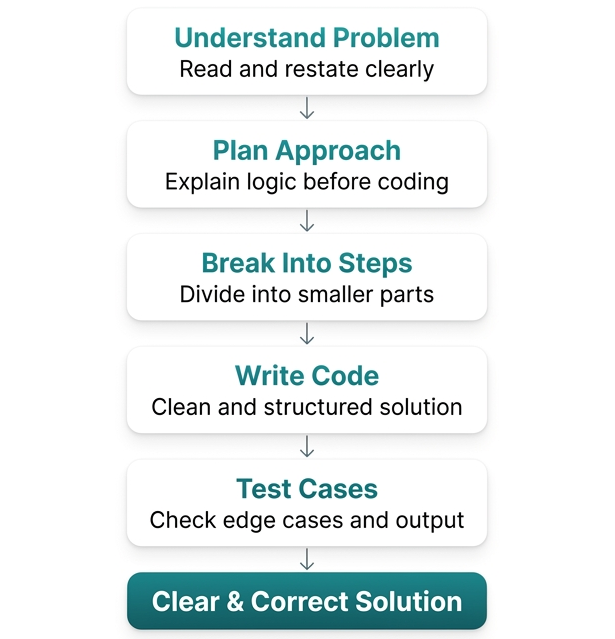
One of the biggest mistakes students make is rushing into coding. Interviews are not coding contests, they are problem-solving discussions. A structured approach helps you stay clear and confident.Step-by-Step Approach
- Understand the Problem Clearly: Restate the question in your own words to confirm you understood it correctly.
- Discuss Your Approach First: Explain how you plan to solve it before writing code. This shows clarity of thought.
- Break the Problem into Steps: Divide the solution into smaller parts instead of thinking about everything at once.
- Write Clean and Simple Code: Focus on readability and correctness rather than trying to be overly clever.
- Test with Examples: Run your solution on small inputs to check for mistakes or edge cases.
Common Mistakes Students Make
Most rejections don’t happen because students lack knowledge. They happen because of avoidable mistakes during preparation. Once you recognize these patterns, it becomes easier to fix them.Here are some mistakes you should avoid:
- Solving Without Understanding: Many students rush through problems without fully understanding the logic, which leads to confusion later.
- Ignoring Revision: Learning new topics without revisiting old ones causes you to forget important concepts.
- Depending on Too Many Resources: Switching between multiple platforms wastes time and breaks consistency.
- Memorizing Instead of Learning: Remembering solutions without understanding the reasoning fails in slightly modified questions.
- Neglecting Communication Practice: Even strong students struggle if they cannot explain their answers clearly.
Simple Daily Plan
You don’t need an unrealistic 10-hour schedule. What matters is a balanced routine that you can follow every day without burnout. Consistency beats intensity in placement preparation.Daily Routine Breakdown
- Concept Learning (1 Hour): Focus on one topic at a time, such as arrays or DBMS, and understand it properly.
- Problem Solving (1–2 Hours): Solve a few targeted questions related to the topic you studied.
- Revision (30 Minutes): Go back to previously solved problems to reinforce your understanding.
- Aptitude Practice (30 Minutes): Practice speed-based questions to prepare for screening rounds.
Turning Point in Preparation
There is a stage in preparation where things start to feel different. Problems that once looked difficult begin to feel familiar. This doesn’t happen because you solved hundreds of questions, it happens because you start recognizing patterns.- You Recognize Problem Patterns: You can quickly relate a new question to something you have solved before.
- You Focus on Approach, Not Just Code: Instead of worrying about syntax, you think about logic first.
- You Make Fewer Repeated Mistakes: Errors you made earlier start disappearing because you understand them better.
- You Feel More Confident Explaining Answers: You can clearly walk someone through your solution without hesitation.
Conclusion
Placement preparation becomes simple when you stop treating it like a huge syllabus and start treating it like a pattern-based process.Once you shift your preparation in that direction, interviews stop feeling random and start feeling predictable. And that’s exactly where real progress begins.You don’t need to know everything.
You need to know what actually gets asked and how to respond to it.
Frequently Asked Questions
1. Do interview questions really repeat?2. What should I prioritize first?Yes, not word-to-word, but the logic and patterns repeat a lot, especially in DSA and aptitude.
3. Is it okay to prepare in less time?Start with arrays, strings, and basic aptitude. These give quick results.
4. How many projects are enough?Yes, if you focus on high-frequency topics instead of everything.
5. What matters most in interviews?Two to three well-understood projects are more than enough.
Clarity of thought. If you can explain your approach clearly, you already stand out.

0 Comments