Table of Contents
What is Python?
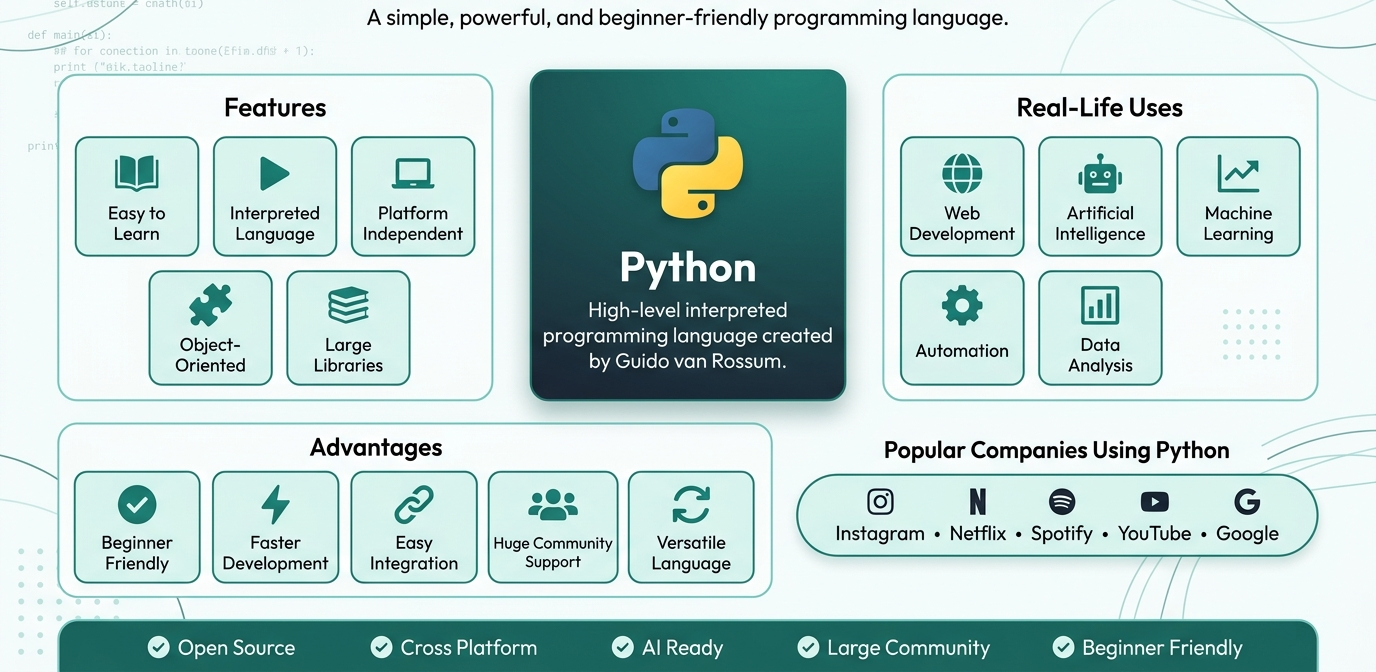
Python is a high-level, interpreted programming language created by Guido van Rossum in 1991. Python was designed to make programming simple, readable, and easy to understand for developers.It is popular among both beginners and professionals because it can be applied in multiple areas of technology. Python is used for web development, automation, data analysis, artificial intelligence, and many other programming tasks.
- Wide Range of Applications: Python is used in several fields such as website development, machine learning, automation, scripting, cloud computing, and data science. This makes it a versatile language for different types of projects.
- Beginner-Friendly Learning Path: Python is often chosen as the first programming language for students because its syntax is easier to understand. Learners can focus more on programming concepts instead of complex code structures.
- Industry-Level Usage: Many companies and developers use Python for creating applications, testing software, handling data, and developing intelligent systems. Its usage has increased across different industries over time.
- Support for Different Project Types: Python can be used for small scripts as well as large-scale applications. Developers use it for desktop software, web applications, automation tools, and analytical projects.
- Growing Demand in Technology: Python continues to remain popular because modern technologies such as artificial intelligence, machine learning, and data analysis frequently use it. Learning Python can help users explore multiple career paths.
Features
Python provides several powerful features that make it one of the most preferred programming languages among developers.- Easy to learn: Python has very simple and readable syntax that makes it easier for beginners to understand its concepts. It is also very similar to English statements, which makes it easy to understand, unlike other complex languages.
- Interpreted language: Python is an interpreted language, which means the code is executed line by line instead of being compiled at once, which makes debugging easier and helps programmers quickly test their code.
- Platform-independent: Python is platform-independent, which means it can run on any operating system such as Linux, Windows, or macOS without such changes.
- Large libraries: Python has a huge collection of built-in libraries and modules which helps u while creating projects, data handling, data analysis, and automation.
- Object-oriented programming: Python supports Object-Oriented Programming concepts like classes, objects, attributes, and methods, which help in keeping it structured.
- Open-Source: Python is an open-source programming language that enables anyone to access, use, and modify it according to their needs and requirements.
- Strong community support: Beginners can easily find tutorials and learn because it has a large global community of developers who regularly post tutorials, frameworks, and solutions.
- Scalability: Python can be used for both small- and large-scale projects. Many companies use Python for making high-performance systems.
- Dynamically typed language: In Python, we don't have to declare the data type of a variable explicitly. Python automatically detects the type according to the assigned value, which makes it faster and easier.
- Integration capabilities: Python can easily integrate with other programming languages and technologies, making it suitable for modern projects and software development.
Examples of Python
Python is widely used in real-world applications because of its non-complex syntax and simplicity; it also supports multiple domains and modern technologies.- Web development: Python is used to build websites and web applications using its Django and Flask frameworks.
- Instagram: It uses Python (via Django) to handle millions of photos daily.
- AI Chatbots: Python is also used to build some AI models due to its simple syntax, which helps in solving mathematical problems and tasks.
- ChatGPT: It heavily utilizes Python, both as its foundational development language and as an active tool to perform tasks.
- Machine learning: Python is widely used for creating machine learning models and data prediction systems.
- Automation and Scripting: Python is used in automation tasks like handling files and data processing.
- Sending emails: Uses libraries to send automated reports or daily reminders directly from your email account.
- Cybersecurity: Ethical hackers and security experts use Python for testing and security analysis.
- Network scanning (port scanner): Python can be used to detect open ports on a target server, which helps security experts to find entry points for attackers.
Real-Life Use Cases
- Instagram Uses for Backend Development: Instagram uses Python for managing millions of users daily, handling its backend systems, and it also helps Instagram improve performance, scalability, and user experience.
- Netflix Uses for Automation and Data Analysis: Netflix uses Python for automation tasks, recommendation systems, and data analysis, and also helps the platform suggest movies and shows based on user interests.
- Spotify Uses for Recommendation Systems: Spotify uses Python to analyze user listening patterns, recommend song playlists, and also helps improve personalized music recommendations for users.
- YouTube Uses for Managing Different System Functionalities: YouTube uses Python for server operation, managing different system functionalities, managing videos, and handling large amounts of data efficiently.
- Google Use For Software Development: Google uses Python in many web applications, automation tools, and internal projects. Its flexibility and simplicity make development faster and more efficient.
Advantages
- Beginner-Friendly: Python is known for its simple, readable, and non-complex syntax, which is similar to English statements.
- Faster Development: Python allows developers to write their programs in fewer lines, which helps in productivity and saves time.
- Huge Career Opportunities: Python is highly in demand in industries like software development, Artificial intelligence, and roughly 80% of data scientists use it.
- Easy Integration: Python can readily integrate with other programming languages and technologies, which makes it suitable for modern technologies and software projects.
- Easy to Learn and Use: Python has a simple and clean syntax, which helps beginners to understand and learn it faster. Developers also find it efficient because of its simple syntax, which helps to create applications in fewer lines.
Conclusion
Python is a flexible, beginner-friendly, and powerful programming language that is widely used across different industries because of its simple syntax, large libraries, and wide range of applications, making it perfect for both beginners and professional developers.Even if someone wants to build websites, automate tasks, analyze data, or work on artificial intelligence, Python is the best choice for modern software development. Due to its growing popularity and industry demand, Python can be a valuable skill for students and developers.
Frequently Asked Questions
1. Is Python easy for beginners?2. Who developed PythonYes, Python is considered as beginner-friendly programming language for its simple and readable syntax.
3. What is Python mainly used for?Python was developed by Guido Van Rossum in 1991.
4. Can Python be used for web development?Python is mainly used in web development, artificial intelligence, data scientist and automation.
5. Is Python free to use?Yes, Python can be used for web development because of its frameworks such as Django and Flask.
Yes, anybody can access, use, and modify according to needs and requirements.

0 Comments